Showing posts with label funny English. Show all posts

Friday, January 25, 2008

Kernel Thunders

The picture that launched many entertaining descriptions.

Back when I was working in a Japanese office and correcting student (correspondence-based) homework as part of my daily duties, there was a lesson in which students were presented with a drawing of an older gentleman and asked to describe him (shown above). It was not the least bit rare for students when describing this man to say variations on several rather entertaining things:
  1. "He is the Uncle of Kentucky."
  2. "He is a dandy."
  3. "He is kernel thunders."
As a further clue, I can tell you that it is often noted that "he has been on a diet" and "he has lost weight."

People who have lived in Japan and especially those who have been English teachers, probably have a clue what these statements are about. For those who don't know, the answer is in the picture below.

Click this picture to see a larger, more detailed picture. Note the poster of a Japan-only KFC food monstrosity to the right of the statue. It's a "mince nan sandwich" (a breaded, deep-fried cutlet full of fatty minced meat served on Indian-style bread). Note the proud display on the burger of the 4th Japanese food group, mayonnaise.

In front of most KFCs in Japan, there is a statue of the Colonel so nearly every Japanese person is familiar with his likeness, though they aren't necessarily all that clear on his name if the reports I corrected are any reflection of reality. It's my guess that Colonel Saunders's visage is so well-known that any older-looking foreign man with glasses, a suit, white hair and a mustache may bring him to mind.

Yes, there is vandalism in Japan.

The statues of the Colonel that I've seen are always clean and very well-kept. The one in the previous picture is so clean that it's super shiny. I imagine that these same sorts of statues would be vandalized rather badly if they were in the U.S. and left out in front of shops overnight. Mind you, it's not that there's no vandalism in Japan, but either the Colonel is not a big target for it or he is quickly cleaned up if it occurs (or they block access to him through gates that they pull down after closing).

I'm not sure why the Japanese franchise owners decided to put statues of the Colonel in front of nearly every shop, but, if I had to guess, I'd think it had something to do with the fact that Ronald McDonald statues used to be in front of a lot of McDonald's. It could be that they felt KFC needed a similar, easily recognizable icon associated with its food.

This papier mache "Hello Kitty" stays in front of this tea shop year round. The owners just change her wardrobe to reflect the changing seasons and holidays. In summer, she wears a bikini and it's frankly a little creepy.

It could also be that the Japanese, in general, have a habit of putting out statues of their corporate mascots in front of shops to attract attention or raise brand awareness. There used to be a Fujiya sweets shop near one of our local stations and a statue of the Fujiya girl ("Peko-chan") licking her upper lip in anticipation of a tasty Fujiya-made treat was placed in front of it. I've also seen statues of various lesser-known mascots in front of other miscellaneous establishments such as a cutesy elephant in front of a drug store and, of course, the omnipresent "Hello Kitty" often shows up in an unofficial capacity.

I wouldn't be surprised if the Colonel, in all his overly-stylized glory, is rather rare as a mascot in Japan that is based on a real (or even fake) person. In fact, I had a discussion with a student last week about Betty Crocker and how a fair number of American mascots resemble real people (or are based on real people) whereas almost all Japanese ones are based on cartoons or cartoon-like images. It's a difference that we don't tend to notice because corporate mascots are part of the background noise of marketing to which we're exposed, though we are all quite aware of and familiar with them in our respective cultures.

Wednesday, August 29, 2007

Silly English/Japanese


If you spend a brief amount of time in Japan, you see people walking around in shirts with funny English on them. If you spend a brief amount of time looking at blogs written by people living in Japan, you see pictures of these sorts of shirts.


Foreign people aren't sure who thinks up the English for these shirts. Sometimes, they are random words and some seem to be long strings of ideas which don't quite come together. One thing is for sure, the Japanese don't care about what these things say in English. They know it's wrong but the lettering itself just looks cool to them.


One of my students wore such a shirt to a lesson last week which made me think that not all the designs are blithely tossed out there or random. Her shirt is not pictured because it would have been rather inappropriate (and rude) for me to ask her to let me snap a picture of her torso for my blog. The shirt she was wearing had the word "sagacious" written down along it in black dots about 8 times with the letters "TNFLTP" written in red about 6 times in front of the repeated"sagacious". If I had seen this as a random shirt on the street, I would have wondered what on earth it was on about and then forgotten it but the student asked me what it meant. I knew "sagacious" meant "shrewd" or "intelligent" but had no idea about TNFLTP.

I looked it up using Google and discovered these letters are part of a genetic sequence. Since I'm not an expert in genetics, I don't know if these letters were coincidentally part of a genetic sequence or if the entire shirt was a sly "in joke" about "intelligent" (sagacious) genes. Following my research a bit further, the sequence seemed to have been related to the DNA of Japanese rice but I'm afraid I was well in over my head at that stage in terms of understanding things. It did make me wonder though if there is hidden meaning or humor in a lot of the funny English shirts we see.


When my student and I discussed this issue, she mentioned that the Japanese don't think clothing with Japanese words is "cool" and they find it pretty unappealing by and large. She said that she noticed when she was in Hawaii that there were people with Japanese/Chinese characters as tattoos as well as on their clothes and that they were often as funny to her as English on shirts is to us.


She said that one of the funniest she saw was a man with a tattoo on his back of a character which meant "sheep". She found it particularly amusing because this was a pretty well-built, masculine fellow walking around with this absurd tattoo, possibly thinking it was really cool.

Thursday, August 23, 2007

Ikebukuro - Part 2

Note: this is a continuation of a post I started here.


Another thing I associate rather strongly with Ikebukuro which is by no means unique to it is long rows of vending machines. There are places in Shinjuku with similarly impressive strings of these eyesores but I think it's burned into my memory as a part of Ikebukuro because this is where I first saw them and I saw them so often. Such copious amounts of these over-lit refrigerators don't tend to appear in the more residential areas (such as the place in which we live) as the foot traffic isn't heavy enough to justify so many in one place. I do wonder how much energy could be saved if the number of these things was forcibly cut in half all over Japan.


I haven't actually been to Ikebukuro for a very long time but my husband recently went there to see a movie with his brother (Harry Potter and the Order of the Phoenix) at a movie theater which specialized in both bowling and movies (two great tastes that don't necessarily go great together). His ticket, which I'm too lazy to scan in and is too crumpled to take a digital photo of, shows a drawing of an old-fashion movie projector next to a bowling ball hitting pins. Classy!

He took the pictures in this post during his visit there and I recognized some of the shops and areas (such as the venerable Jean's Mate shop pictured above) but other places were built since I was last there. Like all of Tokyo, Ikebukuro is in a constant state of being torn down and being built back up again. Many of the places my husband took pictures of are the type with "funny English" on them so I'm pretty sure I'd remember them if they had been there before. Of course, it's also possible that they simply weren't places I came across in my then daily explorations.


The English school above is either ran by a fellow named "Sirius" or is named with a misspelled name. I'd bet on the latter. It sort of takes the wind out of the sails that this is a "serious" place to study if that is the case. The faded sign (under the "GA") of the letters "A", "B", and "C" with an apple, ball and a car don't do much to enhance the reputation of the school. It looks rather sad, slapped together and run-down, but these types of little schools can be better places for foreigners to work because they don't carry the corporate mentality of the large chain schools. Of course, they can also be worse because they are often strapped for cash and having difficulty competing and are therefore understaffed and overwork their teachers.


While a "chat club" carries overtones of a place where people get together and, well, chat, the sign below this says this is a karaoke pub. Why waste time actually talking with your friends when you can get up and sing some cheesy songs? The blue part of the sign says "all time" which I'm guessing means that the price for drunkenly crooning out a tune doesn't change during peak hours. The price is 2000 yen ($17.50) for a half hour or a bargain 3800 yen ($33) for an hour.


My husband got a big kick out of this custom sports clothing business's slogan. The slogan is supposed to indicate originality but manages to convey the notion that everyone gets the same one. Personally, I like the "sweat wear" option and the odd use of "etc." at the end. Even though the logo seems to say "1/80", the business is actually called "Eighties" and was named for the year of its creation rather than a way that represents the contents of its business.


This is a picture of the shop itself where you can order as few as 5 custom-designed bits of sports apparel for your team or gaggle of school girls. It's individualized conformity. You can look like everyone else in your group but not like anyone in any other group.

Outside the shop, there is a bin of Disney T-shirts complete with a hand-drawn Mickey Mouse on the sign. I wouldn't be surprised if the shirts were illegal knock-offs. Perhaps these school girls are shopping for matching "sweat wear" or possibly even those slouchy socks that were all the rage among the uniformed set some time ago.


Some shops are unforgettable even if they don't have funny names or slogans. There's something about a black and lime-green undies shop that you don't forget. Shops with names like this sound incredibly narcissistic but the truth is that such shops are really all about what men want rather than about what the women who shop in them desire deep down. Underwear is, after all, under your clothing, and the only one who sees it are those who are intimate with you (and yourself when you do laundry and spend all of a minute getting dressed). Why would anyone pay more for itchy, tacky undergarments just for themselves? And if you don't think what you see in the window qualifies as "tacky", check out the web site. A lot of it is porn star fantasy crap. I guess men have to have something interesting to steal off of clothes lines and stash under their pillows at night or to sell to those "used underwear" shops in Japan.


If you click and look at the larger picture, you'll see the sign says "Cool! Bowling and, many amusements are here" in addition to "Exitment (sic) batting". There's also "infomation" under the "Cool" sign. It's a veritable cornucopia of misspelling but the Japanese don't care. They just think English on signs looks cooler than Japanese.


Looking over the pictures my husband took and thinking back on my time working in Ikebukuro, I found myself wondering why I never go there anymore. It clearly has everything you could want in terms of shops, restaurants, and entertainment but it's not the sort of place people tend to go unless it's where they work, live, or have to go for some reason or another. For instance, I've never heard a student say they're headed for Ikebukuro this weekend. They always go to Shinjuku, Roppongi, Ginza or one of the other big name shopping and entertainment districts.

I guess part of the reason I don't go there is that one doesn't need to go to Ikebukuro if one lives closer to one of the other areas because there's little there which you can't get elsewhere. While it is a one-stop for nearly anything you might desire, it's not what my husband would call a "happening place." It's a nice place to live (or work) but you wouldn't want to visit there.

Friday, August 10, 2007

The Heat

Today has been the hottest day of the year so far in Tokyo and I had a chat about the weather with "little old man" (LOM) before he launched into a long talk about how he spent a sweaty but "exciting" time on the golf driving range. LOM loves his golf. He once spent three lessons getting through telling me about one game in minute detail.

Getting back to the weather though, LOM told me that one of the effects of all this heat is that he doesn't sleep very well. He said he has an air conditioner but he doesn't like to use it all night so he puts it on a 30-minute timer just before bed and when the heat inevitably wakes him up again and again, he runs it each time on a 30-minute timer because he thinks running it all night is going to cause him to freeze to death or get very sick.

After telling me about this drawback of the heat, he wanted to tell me about some other ill effect so he pulled out his electronic dictionary and started poking at the keys. He slowly said that the heat makes him "im-po-tience". I was pretty sure he didn't mean what it sounded like so I just smiled and said, "impo... what?" He repeated "impotience" and I asked to see his dictionary at which point I realized he meant, "impatient".

Sometimes I wonder what the students would think if they could read my mind when such little errors occur. Generally speaking, I'm rather glad they can't.

Friday, June 22, 2007

A Shop You Must Go Into

Back when I was still an Apple zealot, I bought a QuickTake 150 camera for a relatively princely sum (at the time). We took a fair number of pictures around Tokyo as well as of our apartment at that time and I recently ran across them while consolidating back-up CDs for transfer to a back-up DVD.

The camera was better than a lot of digital cameras at that time but not nearly as good as those that soon followed. One problem was that it didn't have a handy-dandy LCD display to preview the shot and its flash was very crude. Another was that the resolution was pretty low. Eventually, the camera's interface (Mac serial bus) was phased out and I then had years without a camera. In fact, I only got a new digital camera just prior to starting this blog and probably never would have started writing it without my new camera.

The pictures we took with the QuickTake were fine as long as they were smallish and outdoors. One of the places my husband took a shot of 11 years ago was a shop in Koenji which I'm certain is no longer there but has to have one of the greatest names ever.


This place has a name you couldn't possibly forget. It also had to be intentionally named in a crude manner. There's simply no way this is one of those "funny English" mistakes that people take so much delight in cataloging on their web sites.


I'm certain my husband and I probably went into this place and looked around though I can't remember anything about it now. It's likely that the goods within weren't nearly as interesting as the shop's name. There are tons of T-shirt shops around Tokyo and after awhile, even the funny English ones start to seem pretty boring. If nothing else, one can see the value in naming your shop right in attracting potential customers. It's too bad that the name probably didn't lure many Japanese customers inside.

Monday, May 21, 2007

"Mr. Sato's Family"


As part of my freelance work, I sometimes correct correspondence homework for my former company. One of the lessons in the lowest level course features a line drawing of a pleasant-looking family that the students are supposed to look at and use the given information to write about the family. This is a pretty basic exercise which allows the students to practice the simple present tense, family relationship words (mother, father, etc.) and possessive adjectives (his, her, etc.). It is meant to prepare them in part for a telephone call where they have to talk about themselves and describe their families.

Almost every report I get reads like the one I have transcribed below (note that I have left the errors intact):

"There are five people in Mr. Sato's family. They are Mr. Sato and his wife and son and daughter and mother. Hiroshi Sato is an accountant. He is 45 years old. He graduated from Waseda Univeristy. His wife's name is Kimiko. She is nurse. She is 40 years old. She graduated from Keio University. His son's name is Taro. He is a high school student. He is 16 years old. His daughter's name is Megumi. She is 8 years old. She is an elementary school student. His mother's name is Michiko. She is widow. She is 65 years old."

If you can imagine this sort of thing multiplied by about, oh, say 1000 then you have an idea of how often I correct this little basic family description with variations in types of errors. As an aside, a frequent error in this passage which did not occur in the one above is calling Michiko "a mother widow" or a "window".

The 1001st report comes from someone with a little imagination and adds in something interesting. The one below particularly tickled my fancy (again, I transcribe it with errors intact):

"There are five people in Mr. Sato's family. They are my debtor. But they disappeared from last month. So, I serch that family and inform some information. In this connection I offer a reward for find this family. In contrast to ten billion dollars. Hiroshi Sato was the accountant on Goldman Sax. He is 45 years old. He graduated from Waseda University. His wife's name is Kimiko. She was the head nurse on Tokyo University Hospital. She is forty years old. She graduated from Keio University. Hiroshi's mother's name is Michiko. She is an widow. So, she often went the host club in Shibuya. She graduated from Ma Institute of Technology. She is 65 years old. Hiroshi's son's name is Taro. He is the Keio high school student. He is sixteen years old. He is playboy. His sisters name is Megumi. She is an elementary school student. Her hobby is investing a money in stocks. She is eight years old."

When I get reports like the latter, I'm always partially amused and partially concerned at the sort of mind that would concoct such a story from a simple, boring line drawing. Mainly, I'm just glad for the break in the monotony.

Wednesday, January 17, 2007

"We Live With Nature"


The picture above is of a tire cover on a Japanese vehicle. It's a little hard to read so I'll type out the text here:

"A long time ago before human was born, there was only woods, grass, animals, birds and fish. When human was born, they helped the newly born baby, offering their bodies. Grass and animals became human's clothings, and then, they protected them from the rain, wind and cold. Winds and grass gave him their fruits, nuts and grains. Animals, birds and fish became human's food, and they grew him up. We will never forget their favors. We never live without nature. 'cause we live with nature."

This is not only a good example of some of the typical errors the Japanese make in Japanese to English translation but points out a very interesting (and somewhat odd) perspective on the food chain.

The author of this passage was either holding his tongue firmly in his or her cheek while writing or believes that nature really wants to make sure man survives. I wonder if it is an off-shoot of shinto beliefs to imply intent in the "sacrifices" that animals, plants, etc. make in order to "nurture" man. Since shintoism includes the belief that a "spiritual essence" resides in all things.

It struck me as relatively quaint as well as reflecting a notion that man is somehow elevated above other living creatures. Why would any living entity sacrifice itself to the survival of another species?

Of course, it could be that this is no more than a reflection of bad translating and the use of words like "offer", "help", "give" and "protect" are misleading choices. You find that translations often skew intent a fair amount and it's important never to reach conclusions without clarification.

Wednesday, December 06, 2006

Bicycle Repairman


My bike broke last week and my husband and I finally got around to taking it to the local repair shop. As you can see from the picture, it's jam-packed with bikes and festively-decorated with a string of Christmas lights (right under the sign). That level of crowding extends into the shop itself where there are extremely narrow isles to walk through.

The picture looks like it was taken at night but it was actually about a quarter to five in the evening. The Japanese don't use daylight savings time so it gets dark early. This is because, as my students put it, "it's not their custom." It seems pretty hypocritical to whine about the U.S. not signing on to the Kyoto accord and then refusing to do something that'd save electricity by turning the clocks forward and back twice a year but nevermind.

My husband believes this bicycle shop is part of a chain of such shops ran by Bridgestone (the tire company). One young fellow works there so you have to wait sometimes if someone gets in ahead of you. In our case, a woman was in front of us so the repairman told us it'd take an hour. We decided to kill the time and be productive by getting some grocery shopping done while he worked. We headed down the local shopping street and my husband noticed these signs (click on this picture to see a more easily readable large version):


He was particularly amused by the idea that your hair needs to relax. I liked how you could get a "blow" for 3,150 yen.

Anyway, my husband was on foot and I was riding his bicycle down the shopping street. You're not supposed to ride bikes on the shopping street but people do it all the time. In fact, there were at least 3 other people in easy view of us also riding bikes but some old goober harassed me about riding mine (tapping my shoulder and pointing at the signs - which shows how slowly I was riding because he was on foot - I was hardly being dangerous). Of course, he ignored all the Japanese people who were on bikes. This frustrates me because I don't ride a bike because I'm lazy. I ride it because of my serious back pain which can become unbearable when I walk for a long time. Generally, walking while shopping is enough to wear out my pain tolerance so having to walk to get to the shops is out of the question. I let the prejudiced old fool walk ahead and got back on my bike again after he'd passed.

My husband wants to treat some of his students to Christmas cookies this year so we were trying to track down ground cloves and ginger for gingerbread cookies. Ground ginger has been especially troublesome for me to find in local shops. I'm guessing this is because it's so easy to get fresh ginger in Japan and it's what they use in their cooking. I've also been able to easily find whole cloves but not ground. Fortunately, a supermarket with a fair number of imports had them. My husband had to go to a shop specializing in imports to buy an expensive bottle of molasses.

Our shopping took about 40 minutes but the repairman hadn't touched the bike while we were gone. He also told us when we returned that he may not have the necessary parts until tomorrow and took our phone number. About 40 minutes after we got home, he called to say he was finished and it'd cost about $30. That's about 1/3 the cost of the entire bike but it's relatively reasonable. And it's a lot better than some of the car repair bills we used to get back home. ;-)

Sunday, November 12, 2006

Just Wonderful

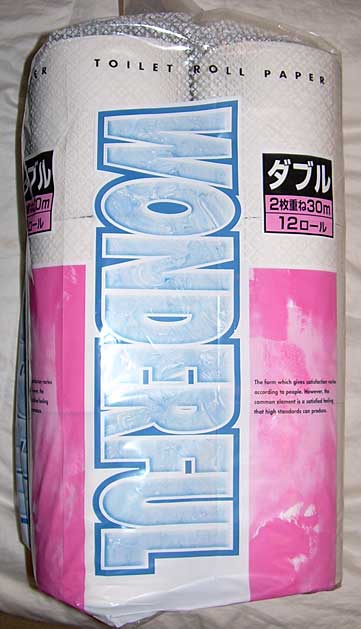
Sometimes I think the weird English on Japanese items is intentionally strange. While I'm sure it's just nonsensical at times because the meaning is unimportant and it's just meant to be decorative wording, I have to think the person who decided to brand this toilet paper as "Wonderful" must have gotten the joke.

Don't get me wrong. I don't intend to start making a bunch of Engrish.com-style postings and go out of my way to take pictures of these sorts of things. In general, I'm far less amused by these things than most foreigners. My husband enjoys these types of things as does his brother but I've grown a little immune to the humor for some reason.

It wasn't even that I found this one so funny but rather that this brand replaced my normal brand of generic el cheapo toilet tissue ("Bell W", cleverly emblazoned with a picture of a bell over a big letter "W") at the local drug store. I must say that this one seems far more enthusiastic about the quality of its product than the former brand.

The little saying on the inset is pictured at the bottom of this post. This seems to be indicating that I'm going to have a far better experience with this tissue than with other brands. It's actually a little creepy to write about having a "satisfied feeling" on a package of toilet paper.

I haven't tried this tissue yet but somehow I doubt it's going to prove more satisfying than my old brand of 200 yen per 12 roll package of toilet paper. There's only so much satisfaction you can get for a little under $2.00.

Sunday, September 10, 2006

Magic Flakes


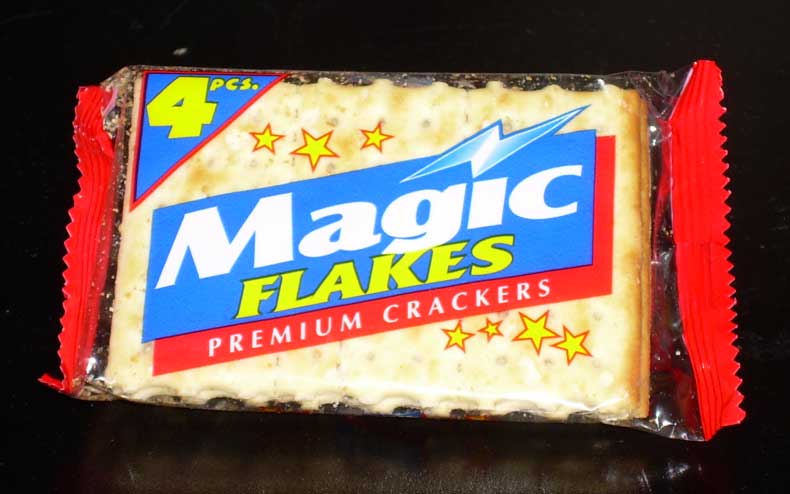
When you're sick, lots of food that has limited appeal starts to seem like the answer to your dreams. Chief among my food wish list when I'm ill are saltine crackers. Unfortunately, I wasn't in any mood to bike or hike off to a supermarket so I decided to scrounge around at the local convenience store called QQ ("99"). This is the type of store that carries smaller packages of things for a cheaper price, some "store brand" items like 99 yen low fat milk, and the occasional import from a country that produces items at companies paying relatively low wages.

My cracker needs were answered by a huge package of "premium" crackers from the Phillipines with the odd name of "Magic Flakes". I'm not sure why they're magic but they are very good, thin, crispy crackers. They're made by a company called Universal Robina which is well-known in the Phillipines and attempting to expand into other Asian markets. Since QQ seems to carry imports you don't tend to see in bigger markets, I'm guessing they're not having the best of luck getting their brands onto shelves in Japan.

I was thinking about how my immediate reaction upon seeing new brands in stores if they aren't produced by a well-known producer is to suspect the product is of dubious quality. It just goes to show how we learn to trust a product more if the company advertises enough to make us feel comfortable with it.

Sunday, August 27, 2006

Messy Hands

There's a chain of stores called Tokyu Hands which specializes in items the Japanese might call "lifestyle goods". Each floor is devoted to different categories of items. It's different from most department stores in that it carries a large selection of craft-making items and DIY tools. Unlike in the U.S., it's rather difficult to locate such things, at least in Tokyo.

I think this is in part because space restrictions in Japanese homes discourage people from pursing more elaborate hobbies such as those related to carpentry. Most men don't have garages they can set up shop in. Most people don't have garages that they can keep their cars in for that matter. The best they tend to have are car ports or parking areas just big enough to park in.

Other reasons probably include the fact that the Japanese already have a whole host of hobbies as part of their culture which are different than western pursuits and men don't seem squeamish about learning things like flower arrangement. The former president of my former company used to proudly display pictures of his flowers.

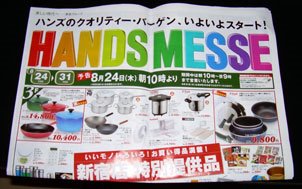
The flyer pictured above says "Hands Quality Bargain" and offers a whole host of items for sale. I'm not sure what "Hands Messe" is supposed to refer to but my best guess is "Hands Message".