Friday, January 26, 2007
Ghosties and Such

Earlier today I was watching a Discovery Channel series called "A Haunting" which recounted the story of a little boy who was being "influenced" by a demonic entity and how his mother eventually rid herself of it. Generally, I don't go in for these types of shows but there was nothing better on and I wanted to watch something while I did some back exercises.
I'm not going to debate whether or not such things are "real" but I will say that I believe we make our own reality and that any manifestations of good or evil in our lives are our own mental constructions made manifest. I'm sure others feel otherwise and that's fine by me. It's not like anyone can prove that they are right or wrong about such things.
The thing that struck me while watching this "docu-drama" (or whatever you want to call it) is that the producers really did a good job of ramping up the potential spookiness factor by adding in cinematic touches which weren't a part of the story. The mother said, while she was attempting to perform a ritual to bar the spirit from influencing her son, that she wasn't sure if the house was going to shake or the windows break . These things never occurred but the camera was shaking to make it seem as though it had. There were also all sorts of spooky sound effects and "demon eye view"shots with a filter on the camera which was rushing in on the woman or her son as if the demon was "watching" or "attacking". This also never happened.
It occurred to me after watching all the work that went into juicing up the story that the audience must be pretty jaded to need cheap horror flick effects tossed into a supposedly true account of a demonic encounter. I also felt that doing these things undermined the emotional impact of the real mother's story as she narrated portions of the story. I guess we've all seen way too many horror movies to be impressed by the mere retelling of a ghost story.


Thursday, January 25, 2007
Not Taking "No" For an Answer
Everyone knows about "the Japan that can't say no" idea. Today, I had an experience I've had rather frequently before in Japan where I encounter a Japanese person who won't take "no" for an answer. The general structure of the conversation is this:
JP = Japanese Person who wants you to do something you can't or don't want to do.
JP: Your student needs to cancel her lesson today and would like to come tomorrow.
Me: I'm afraid I'm busy tomorrow so I can't schedule a lesson for her then.
JP: She wants to come after 6:00 pm.
Me: I'm sorry but I'm especially busy after 6:00 pm.
JP: You're busy?
Me: Yes. Can she come next week?
JP: She would like to come tomorrow.
Me: I'm very busy tomorrow.
JP: You're too busy?
Me: Yes. I have other lessons.
(uncomfortable prolonged silence)
Me: (giving in first) Can she come next Thursday for her usual lesson?
JP: She would like to come on Friday.
Me: I'm sorry but I can't see her then.
(second uncomfortable silence)
Me: Please tell her I'm sorry I can't see her tomorrow.
JP: Okay, I'll tell her then.
As you can see, I'm pretty weak under the pressure of silence. I think this is a combination two things. First is the fact that I'm a teacher and any time I talk to a Japanese person, I feel it's my obligation to keep the conversation going. Second is because I was raised by a mother who made me feel like I was the most selfish person in the world if I didn't do everything I could to make everyone else happy even if I have to do so at my expense.
I don't have trouble asserting myself or making my opinions known but I do have problems saying "no" when I'm doing so for my own benefit. In this case, I was refusing a student who I don't really enjoy teaching because I already have 4 hours of lessons set up and that's going to be tiring enough without shoehorning her into the day. The main reason to turn her down is that it'll wear me out too much.
This problem is sufficiently an issue with me that I consider it a triumph every time I say "no" to someone because I don't feel like doing what they want for one reason or another. I'm sure this is a neurotic tendency but it's rather hard to overcome the conditioning I grew up with.
Despite a reputation for being polite and accommodating, the Japanese are just as capable of exerting pressure as anyone else. They just tend to do it in a more subtle fashion through repetition and silence rather than through volume or aggressiveness.
Wednesday, January 24, 2007
Of Blogger and Browsers
I usually post from Firefox on my PC but I was working on the Mac today and decided I'd post from the Mac. Unfortunately, I was in for an annoying surprise when I attempted to use Safari to post.
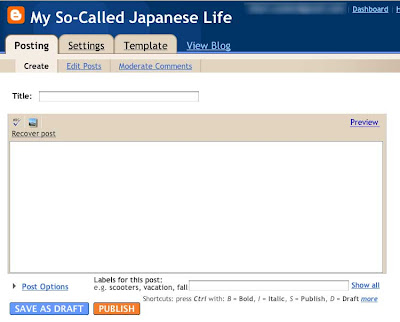
The screenshot above (click on it to see a bigger, easier to read version) is what the screen looks like when I use Safari. If you look at the toolbar across the top (just under the "Title" box), you can see there are only two icons. From Safari, the only thing you can do is spellcheck or add a picture.
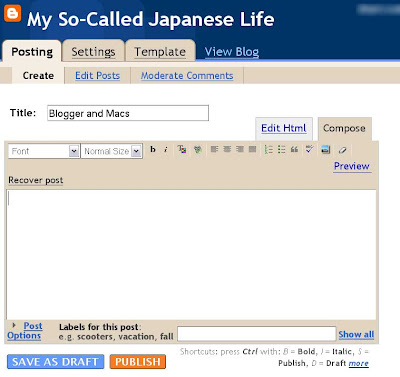
The screenshot above is from Firefox on the PC and, as you can see, there's an entire row of options when posting including font type, size, style and color, linking, paragraph alignment, list formatting, spellchecking, picture addition, and format erasing.
I'm not sure if the absence of these options on Safari is because of Apple's coding of Safari or if it's related to Blogger not supporting the Mac's default browser. Either way, it's yet another reason to use Firefox.

The screenshot above (click on it to see a bigger, easier to read version) is what the screen looks like when I use Safari. If you look at the toolbar across the top (just under the "Title" box), you can see there are only two icons. From Safari, the only thing you can do is spellcheck or add a picture.

The screenshot above is from Firefox on the PC and, as you can see, there's an entire row of options when posting including font type, size, style and color, linking, paragraph alignment, list formatting, spellchecking, picture addition, and format erasing.
I'm not sure if the absence of these options on Safari is because of Apple's coding of Safari or if it's related to Blogger not supporting the Mac's default browser. Either way, it's yet another reason to use Firefox.
Househusband/Housewife
My husband and I have had a rather unusual arrangement throughout most of our marriage regarding our work since coming to Japan. When we first arrived, we both worked full-time for 2 years then I quit to have gall bladder surgery (and because I hated my job). I recovered from surgery for about a year and a half and was a housewife who taught about 3-5 private lessons a week at home during that time.
I then worked at a temporary job which turned permanent while my husband continued to work at his language school. Several years into my work at an office that sold correspondence lessons in English, my husband started having some troubling health issues including asthma, constant fatigue and the inability to get completely well after a series of minor illnesses. At that point, my job seemed stable and I encouraged him to quit and I'd support us. He was a "househusband" for about a year and then started to work as a temporary employee at the office at which I was employed. He worked between 3 1/2 and 8 months of each year over nearly the next decade.
The time when I was relatively healthy and we were able to work together in the same office on the same schedule was pretty much the best time we have had. We would have continued this schedule if it weren't for my former company's decline in business reducing the number of months we could work together. Eventually, it looked as though they might not even need my husband full-time for 3 1/2 months each year and that was pretty much the point at which it became clear that he would have to find work elsewhere and our "golden age" of togetherness was going to end. Also, my health was in shambles and he'd been encouraging me to quit my job for years and he knew the only way I'd do it would be if he was in a stable relatively permanent, full-time situation.
One point that was really brought home to both of us during the times when one of us was handling housework full-time (for the most part) is that there is a definite increase in overall quality of life when someone takes care of the domestic work and you're not cramming it all in at the beginning and end of a workday. You eat better and more cheaply because someone has time to shop and cook nutritious meals. You live in a cleaner and more healthy environment. Both parties are less tense because there's less rushing about trying to get things done and the person who works gets more genuine resting time while home.
Our work situation has mainly been shaped by our desire to have as much time together as possible and, to a lesser extent, health problems for one or the other of us. I quit my full-time work a year ago because of my health but I think I may have hung in there longer if the schedule he got at his new job hadn't pushed us to have only one day off in common together and to work schedules which forced us to spend 4 hours of any day in which we were both working apart due to schedule discrepancies.
I'm sure we could have saved more money or we may have left Japan by now if we had both worked full-time all the time but I wouldn't trade the togetherness we have had for any amount of money or comfort back home. You can't have that time back once its gone and the opportunities we have had to work together are rare in any country. The way in which my husband and I can structure our lives to be together so much is one of the biggest reasons we've been here so long and one of the reasons we are somewhat reluctant to leave.
Monday, January 22, 2007
A "Why" Person
All my life, I've been a person who wants to know "why" things are the case. This is particularly so when it comes to human behavior and probably is part of what lead me to study psychology in university.
In my young adult days, this level of curiosity allowed me to be a relatively good social animal. People in their 20's are more than happy to mull over the details of their lives and allow you to explore their background and the motives of everyone around them.
In my first job after college (at a halfway house for mentally ill people), one of my coworkers once said that I was remarkably curious. I'm not sure if this was a polite way of saying I was too damn nosy or if this was an observation he made because I wanted to understand the dynamic behind the way people interacted and the ways in which their characters developed.
This particular coworker was the first person to recognize that all my curiosity lead to uncommon (and sometimes uncanny) insight into people's lives. I've been able to tell when coworkers were lying about college degrees and if friends grew up with alcoholic parents when they didn't say a word about either of these situations. I can read the past through attitudes and actions rather quickly (generally in the first meeting) though I rarely actually say what I think to people because it would be rude or too personal.
The funny thing is that this former coworker was the only person to ever overestimate how I "knew things" about people in what appeared to be an act of semi-clairvoyance (no, I don't believe it was clairvoyance...I believe it's the equivalent of figuring out the picture of a puzzle from seeing just a few pieces). This was the result of a very unlikely secret that my coworker had in common with a former classmate of mine from university. When I told my coworker that my former classmate had a secret son with an older woman he'd slept with once when he was quite young, he believed I'd related that story as an oblique way of letting him know I'd worked out his secret (which was the same one). Of course, this was back in the days when such things were kept a secret because they carried an element of shame. I can read a lot about people but I didn't work that out.
As I've gotten older though, and the people close to me have reached their 40's, I've found that my tendency to want to explore and theorize why things are happening has begun to be a source of frustration to those around me. When my husband is sick, I ponder the roots of his illness aloud and he doesn't want to hear it because it's of no help to him in getting well (and he feels it may hinder him because it makes him dwell on it more). When my sister tells me about my parents' increasingly regressive behavior, she doesn't want to discuss why they are doing what they do because it doesn't help her cope with how hard it is to live with them.
I've been trying to curb this tendency but I note to myself with irony that I wonder why people some aren't as curious about these things as I am. I guess I have some ways to go.
Subscribe to:
Posts (Atom)