Just prior to the start of the New Year's holiday, most Japanese people embark on a serious cleaning jag (sususarai). This often includes tossing out junk that has been cluttering their homes and doing deep cleaning of various areas.
Most of my students say they will be doing this sort of cleaning but not all. Some say they can't be bothered or will just be doing more usual cursory cleaning so not everyone does this. I equate this cleaning to what is commonly done during spring cleaning in the U.S. Personally, I try to do this sort of thing on an on-going basis so I don't have to do it all at once.
During my years at my former company, I witnessed the office equivalent of this pre-holiday clean-up. On the last day of work before the holiday (which usually lasts a week for most Japanese employees), most of the Japanese employees would come to the office in casual clothes and commence with scouring the office from top to bottom. This generally included scrubbing floors, washing windows, removing and cleaning light fixtures and bulbs, and cleaning out desks of accumulated paperwork and junk.
Every year, the foreign employees worked as usual on this day because our schedule was not modified to allow us to assist. We'd have to do scheduled telephone lessons and mark homework while the Japanese toiled away happily. Of course, not everyone toiled. My boss and I amused ourselves each year by noting who managed not to do any heavy cleaning work.
One of the more senior salesmen was particularly slack and made such a chore of tidying his desk that he never touched the vacuum cleaner or scrubbed a surface. He managed to do this for every one of the 10 years he worked in the office with us. Eventually, he was transferred to another office and quit soon thereafter. I'm pretty sure his laziness at cleaning time was linked to a certain lackadaisical attitude toward his work which eventually got him fired Japan-style (that is, put into an undesirable situation which is meant to force one to quit).
The president's wife, who worked part-time at the office, carped about how inadequate the office ladies were at cleaning the tiny office kitchen or how lazy they were. She felt they should scrub the floor under all the furniture and scrub off the front of every cabinet. When they refused to do it, she did it herself so she deserves credit for getting down and dirty as she expected others to do.
The idiosyncratic and mercurial fellow who owned the company and acted as president sold us off after my first 10 years at the company and a cleaning company handled the office cleaning when new ownership took over. Apparently, only small, cheap companies force their employees to do this clean-up and most places have outside help do the year-end scrub-down.
I'm sure that the Japanese workers were happy to not have to do the end of each year janitorial duties but there was a camaraderie in it all that was likely lost. During this last day, people not only dressed informally but also could break out of their usual roles in the office and they tended to be more jovial and let their hair down a bit. Interestingly, their zealousness for cleaning always mirrored their general work ethic.
The company also bought their lunch and had it delivered (though the foreign employees were not included in this) and there was a little "party" of sorts at the end where snacks were served and the beer from the winter gifts was consumed.
Quite often, I was the last one to leave on such days because the Japanese workers could leave when the cleaning was done and my schedule was full and finished at a later time or I would work the next day (a Saturday) alone. I always had a strong sense of being abandoned in a sterile room which wasn't going to be touched for some time.
After the party, a traditional New Year's ornament (shimenawa - Roy has a nice picture of one here on his blog) was hung on the front door and everyone headed off for vacation. Seeing these decorations on closed shops in my neighborhood on New Year's day always fills me with a strong sense of completion and an odd sense of emptiness. I will always associate these decorations with hard work that has been completed, a fresh and clean area prepared, and everyone deserting the premises because of my years of witnessing the yearly cleaning at my office.
Sunday, December 31, 2006


Saturday, December 30, 2006
My 2006
 Goodbye, year of the dog.
- I started this blog as a means of fulfilling a desire to write and to record my thoughts and experiences living in Japan. I did so with a great many trepidations because so many blogs are ego trips. However, I was greatly inspired by the blogs that I enjoy which I feel are not about overt ego gratification or self-involvement. My primary "style" inspiration has been Q-taro as I've always enjoyed Roy's posts about his observations and life in Japan.
- I started writing for blogcritics to force myself to write in a more structured manner and to try and push myself to recapture some of my old academic writing style. I haven't written as often as I'd like but have been largely satisfied with how I've written. However, I hope to do better next year and with greater frequency.
- I learned how to pump up a bicycle tire. Previously, my husband had always taken care of this little task. It was a good example of some easy little thing which you never bother to learn because someone else did it that you finally get around to tackling.
- I seriously considered getting a distance Master's degree in adult education from Penn State University and even tracked down two references from my old professors who graciously recalled me after 20 years. I gave up on the idea when I considered the expense and my income. Ironically, money was the reason I didn't go to grad school when I first graduated from university and it's still a factor now.
- My husband and I had to replace a great many things at not inconsiderable expense including his entire wardrobe (down to the shoes and ties), his eyeglasses, my computer monitor, his notebook computer, our DVD player, telephone, my bed-side lamp, my pillows and our bed comforter. Considering our income was greatly reduced this year, I'm amazed that we managed this without going into debt.
- I started private teaching in February after not having done so for about a decade. After working in an office for so long, I was pretty insecure about going back to face to face teaching but it's like riding a bike. You never forget how to do it.
- I developed a new recurring, annoying, and painful psychosomatic illness or an allergy. I'm not sure which yet but I'll have to work harder at relaxing so it doesn't happen again. I'm aware of what a contradiction in terms that statement appears to be.
- My kitchen floor was replaced.
- I installed a video card in my PC.
- I did my largest volunteer project to date and laid out a complete 270-page cookbook for my sister's library. It looked beautiful and allowed me to learn to use the automatic indexing and table of contents functions of Adobe InDesign. Unfortunately, due to some conflicts with the new director at the library, the entire effort will not be used. I even busted my ass while very sick to get it done by an absurdly early deadline (which I made but has since been indefinitely extended). I have a lovely, complete cookbook but no one will ever see it. Needless to say, this was a very disappointing experience.
- My friendship with my friend Shawn was revived to full life after lapsing for about a year. This wasn't one of those falling-out things. It was more about lives going in different directions. I'm glad our paths re-converged.
- I started playing Guild Wars after a long absence from on-line multiplayer gaming.
- My husband started going swimming at a local health club after a very long absence from it. He did this after I found a flyer for reduced cost membership in our mailbox. Sometimes the junk they constantly cram in our mailbox is actually useful.
- I rearranged the furniture in our bedroom so the air conditioning would hit my husband. This included laying down a mat "carpet". I did it all by myself and it was a Herculean task but it is functionally a much better arrangement.
- We paid $6,000 in health insurance and reduced our bank account to $15 thanks to the way in which health insurance is calculated based on last year's income and my, ahem, delinquent payment from a previous year.
- I got a new digital camera courtesy of my father-in-law.
- I finally read my husband's Harry Potter fan fiction novels (which he wrote 2 years ago).
- I captured all of my home VHS video tapes and converted them to playable DVDs.
- I budgeted for the first time since coming to Japan and formed a fact-based understanding of how much it costs to live in Tokyo for the first time. However, it was so tedious that I stopped after 2 months but that was long enough to get an accurate picture of our situation.
- I made a conscious and conscientious effort to learn new recipes and vary our meals now that I have to cook most of the time to reduce expenses.
- My last uncle (I had 3) passed away. I hardly knew him but I still felt bad for my mother and the rest of the family.
- I've written a lot of content for lessons which could be developed further into a textbook for cultural discussions and have pondered doing just that.
 Hello, year of the boar.
Friday, December 29, 2006
Corrections That Are Incorrect
Back when I was in college, my Spanish teacher thought it was his job to enlighten us about news of which we should be socially conscious (rather than simply teach us how to speak Spanish). This was around the time that every bleeding heart rock singer and his brother were using the situation in South Africa to advance their media exposure. It was also while Nelson Mandela was still in jail.
This teacher asked the class if they knew what the problem was called and I raised my hand and said "apartheid" pronouncing it correctly and he reiterated my reply by saying "a-par-THede". He clearly was pronouncing it incorrectly but was not so subtly attempting to "correct" me.
Among the things I've overheard many times while working as a teacher is other teachers offering up corrections which are incorrect, giving out incorrect information, serving up dubious theories, and making serious grammatical errors themselves. My husband says he overhears a fair amount of such behavior in his work as well, particularly from certain specific teachers.
One of my former coworkers (who was a total nightmare) had the "dog" and "cat" theory of personality which he felt students needed to know and understand. I never really sat through the whole lecture but multiple exposure to snippets of his bizarre theory indicated that bad people were supposed to have the personality of dogs and good people that of cats (or vice versa). I can only imagine what the students thought of this notion and what it said about western people if they felt it necessary to reverse-anthropomorphize themselves in such a fashion.
Even when the students know the teacher is wrong (as was the case with my Spanish teacher and myself) or full of baloney (as was the case with the "dog" and "cat" guy), they don't say anything. In some cases, they resist out of uncertainty. In others, they don't want to anger the teacher out of fear about how it'll affect their grade or rapport with the teacher. I'm guessing in some cases it's also about being polite.
To be honest, I occasionally misspeak and make a grammatical error (as I'm sure everyone does) but I always correct myself. I think some people are embarrassed to acknowledge a slip of the tongue with self-correction and some people aren't aware that they're making mistakes. Teachers aren't perfect, no matter how educated they are or how hard they try. Still, it's hard not to cringe when you hear someone reinforcing a mistake with students or making their correct English incorrect.
Thursday, December 28, 2006
Turkish Delights
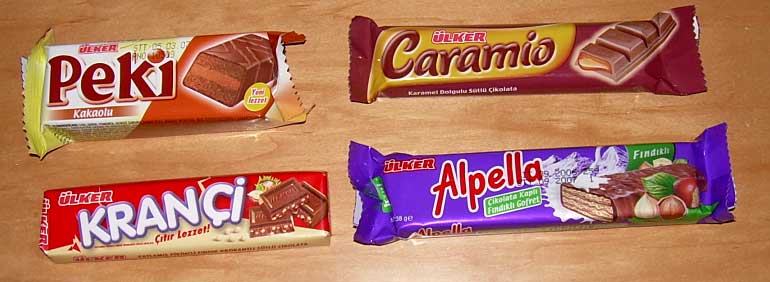
The Turkish coffee shop where my husband acquired dates (as I mentioned in a previous post) also carries imported candy bars. My husband doesn't tend to buy these types of things very often. However, he is often compelled to purchase such things when he comes across something we've never seen before, particularly if it is not made in Japan. I guess that buying chocolates only when they are novel is one way to reduce the frequency of one's consumption of sweets. These bars were relatively expensive so that would probably dissuade us from repeat consumption on a regular basis if nothing else does.
All of these bars were produced in Turkey and have information on them in 4 languages including Turkish and English. One of them also has Arabic writing. It's specifically stated on one that it contains "no lard and alcohol". I'm guessing this is to make it clear that it is acceptable for those of the Islamic faith.
My husband and I split the Alpella bar this evening and I had a small nibble of the Peki and Kranci bars. The Alpella was incredibly good and it required a great deal of restraint not to gobble it down in its entirety. It's wafers full of hazelnut creme (my favorite). The name "Alpella" is clearly meant as a play on "Alpine" and "Caramio" for caramel.
"Peki" means "okay" in Turkish and I'm guessing it is a translation of the Nestle "Yes" bar (which this bar closely resembles). There's no Nestle logo on the bar so it's either a rip-off or Nestle doesn't include its logo on it's Turkish products. I didn't care much for the Peki as it seemed overly sweet and had what I felt was an odd texture. The Kranci is straightforward chocolate covered specs of hazelnut.
My husband and I rarely buy Japanese chocolate except for the occasional special Kit-Kat once in a blue moon. I'm pretty sure Japan must have the world's record for greatest number of Kit-Kat flavor variations. To date, I have seen white chocolate, pumpkin, lemon cheesecake, green tea, cappuccino, coconut, strawberry, banana, mango, maple, sakura (cherry), adzuki (red bean), bitter, mild bitter, passion fruit, yogurt and there are several white chocolate varieties made with various kinds of milk from different regions of Japan.
The Wikipedia entry on Kit-Kats lists an even greater variety than I have personally seen. It also mentions that they are the number one candy bar in Japan and that "kitto katto" roughly translates into "I hope you succeed". That last bit of information was news to me. I'm sure it doesn't hurt to have a name that translates appealingly though I think the general appeal of a chocolate-covered wafer and an infinite variety of possibilities has a lot more to do with its success. One thing the Japanese market seems to love is novelty.
Wednesday, December 27, 2006
Fake Concern
One of my students works for a major electronics manufacturer and has been working a lot of overtime over the past 6 months. Recently, she had planned to go to Australia for a vacation with her husband on the heels of a business trip to Hong Kong. Unfortunately, due to her poor health from working too much, she couldn't go to Australia.
During her last lesson with me, she related some details of her business trip to Hong Kong which were of interest. She said that she was feeling under the weather during the trip and her manager insisted that she return prematurely to Japan. He said that he, as the boss, was responsible for her health and well-being.
After a day's rest, she insisted that she was fine and could remain in Hong Kong for the duration of the trip. The manager told her she had to go anyway and reiterated his responsibility. My student said that she couldn't understand his logic because, if he were so concerned about her health, it would make sense that he'd stop working her so hard in Japan.
My student's naivete left me somewhat amused. I guess she's not cynical enough to realize that her boss had no concern for her health per se. He was worried about her becoming ill in Hong Kong because she'd have to go to a hospital there and the company would have to pay the expense. Additionally, her travel arrangements (hotel, plane tickets) may have to be adjusted in a manner which would cost the company more money. The reason he didn't express concern for her health in Japan is that working her to the point of illness in Japan costs the company nothing. If she misses work due to illness, her work just piles up and she has to work that much harder upon her eventual return.
Fortunately for her, she's being changed to a different area of work and will have a different boss. She told me her new boss will be a woman and her new work will be about dealing with advertising on the web in English. I'm not so sure she'll endure any less stress but she's fairly confident that her days of working overnight or until the wee hours of the morning are over.
Subscribe to:
Posts (Atom)