Thursday, December 13, 2007

Wikipedia and Sheldon


I wish the Sheldon comic (pinched from the Sheldon site, which everyone should read everyday because it's momentous uberness should not be denied) I've pasted above had been available when I wrote my "Know It All" post. Of course, if it had been, I wouldn't have had to be so verbose.

Now, I have no choice but to bring it to your attention after the fact in what will appear to be a very cheap attempt to boost my post account for this month. Rest assured, I don't give a toss about post counts. However, I do care about directing readers to a really good web comic which makes points I want to make.

Hanamasa

The spoils of a trip to Hanamasa.

When my husband and I first arrived in Japan, there was pretty much no such thing as bulk food shopping for the average consumer in Tokyo. There are several reasons why this is the case though I'm not sure which is the primary one. If I had to guess, I'd say it's because the small size of domiciles makes it difficult to store large quantities of items is the biggest reason. Another is that married Japanese women used to be housewives for the most part and they had the time and inclination to shop every day. Finally, the Japanese value freshness and feel uncomfortable buying a lot of something and keeping it around for awhile.

While most families still don't shop for items they can purchase in bulk, restaurants do need to get supplies somewhere and that is where Hanamasa supermarket seems to have gotten its start. Back when we first encountered it, part of the advertising indicated that it was focused on (possibly small) restaurant supply. Given the huge quantities you could buy in one package, this made sense.

The origins of Hanamasa are in meat sales (it began with a butcher shop) and that's reflected in the selections they offer. At the picture at the top of this post, you'll see smoked chicken, sliced ham (named "Winning Ham"), and two kinds of sausage. "Meister Rudolf's" is Hanamasa's brand designed to imitate German-made meat products and a lot of the sausage is pretty fatty. When we cook it, we usually drain off as much as possible and blot them on paper towels. For meat, the prices are relatively economical. Five hundred grams (about 1 lb.) of hot sausage is ¥418 ($3.72) and 2.2 lbs. (1 kg.) of "bologna sausage" is ¥1,080 ($9.66). The only down side to the large portions is that it's too much to eat before it spoils so you really need to repackage and freeze portions.

In addition to their own brand-name products, they carry a constant supply of imports including cheese. Pictured above are mozzarella, Gouda (both from Australia), and red cheddar (from New Zealand). The prices recently went up from 100 yen (89 cents) per 100 grams (3.5 oz.) to 130 yen ($1.16) per 100 grams, but it's still cheaper than imported cheese in most markets in Japan. The blocks above are 1 kg. (2.2 lbs.) each and most cheese is sold in these large portions, but it keeps exceptionally well if you re-seal it in the same wrapping that it comes in. Cheese isn't supposed to be kept in plastic wrap and will get moldy faster if it can't breath.

While Hanamasa does carry fresh fruit and vegetables, they aren't a great deal cheaper than other outlets. I've also found that some of the fruit seems a bit past its prime, but I can't say that I've shopped for such items at Hanamasa often enough to say that that is consistently the case.


Finally, imported goodies are available sporadically. If you find something you like at Hanamasa, you have to stock up because there's every chance that they won't be around next time you visit.

••••••••••••••••••••••••••••


As an aside, the day my husband shopped at Hanamasa, one of his students gave him the South Park tote bag pictured above. Somehow, it seems appropriate that a bag talking about Salisbury Steak day was given to him on the day he went to a place that specializes in meat. It also came in pretty handy for carrying some of the items he bought back home.

Wednesday, December 12, 2007

Being an HSP

When I was working in an office in Japan, I worked in a little cubicle alone much of the time. When my boss came into the room and spoke to me from behind my back, I nearly jumped out of my skin. This didn't happen a few times. It happened nearly every time. To his credit, he did what he could to try and warn me that he was coming and even resorted to knocking lightly on the cubicle frame as a last resort to stop from startling me (this worked but he couldn't always remember to do it).

All of my life, I have been hyper-sensitive to changes in my environment. If it is a strong change, like headlights in a dark night, it is often physically painful for me. If it's a mild change, like my boss walking into the room unexpectedly, I get startled. I've also always been very aware of very subtle things which others do not experience. I smell scents others cannot detect until the threshold increases. I can also tell mood changes with extremely subtle cues and the moods of others have a profound effect on me.

In the case of my husband, I can even predict what he is thinking by looking at his face. I'm not talking about generalized thoughts but specific ones. One evening as he prepared to hop into the shower, I knew by his movements and face that he was going to think about a story he was writing while he showered. When he came out, I said, "you were thinking about your story, weren't you?" He said that he was and wondered how I knew since we hadn't said anything about it in the recent past. I could just tell by his state of mind as reflected in his body language.

This state of hyper-awareness can be both a blessing and curse. While I can read people easily, the messages I detect can easily send my mood veering off into a negative direction. I also find that being in a noisy, bright, or visually "busy" place to be overstimulating. The commute to and from my office, which used to be about 12 minutes when I worked in Nishi-Shinjuku, became almost unbearable when it was extended to 45 minutes when my office moved to Kudanshita.

Quite some time ago, I came across a book by Elaine Aron called "The Highly Sensitive Person" (or, HSP). The theory and content of this book was a revelation for me because it explained so much about why I was different from most other people in terms of my propensity to be exhausted, depressed, or overwhelmed when others in my situation were apparently unfazed. Prior to reading this book, I didn't know that others weren't having the difficulties I had because their nervous system didn't process stimuli in the same manner as mine did. I just believed there was something wrong with me psychologically and that I was inferior in my inability to handle daily life.

For me, life is like living in a noisy room with overly-bright lights and a wall paper pattern which is so ugly and fussy that it gives me a headache to look at it all the time. This isn't an emotional short-coming on my part (though people around you like to view it that way), but just a difference in my biological wiring. People who called me oversensitive or thought I was a big baby for getting stressed out under conditions which annoyed them but didn't push them over the edge aren't living in my skin and have no idea what I go through because they are comfortable in their certainty that everyone experiences the world exactly as they do.

The best thing about knowing you're an HSP isn't that it gives you an excuse to withdraw or react badly. The best thing is that knowing it puts you in a position to monitor your responses to stimuli and to see an overload coming. You can derail an emotional short circuit before it happens and stop yourself from lashing out at others when the pain overwhelms you. If the people you live with understand what life is like for you, they can know that withdrawing to some place dark and quiet isn't a form of punishment or a means of expressing anger in some sort of passive-aggressive way, but a method of coping with how overwhelmed you feel. It also allows you to know your limits and plan your activities around what you know you can handle. Best of all though, you can stop beating yourself up for feeling somehow less adequate than people who were born with the sense-equivalent of a suit of armor. You know that you were born with the sense-equivalent of a paper dressing gown and you had no damn choice about it.

Tuesday, December 11, 2007

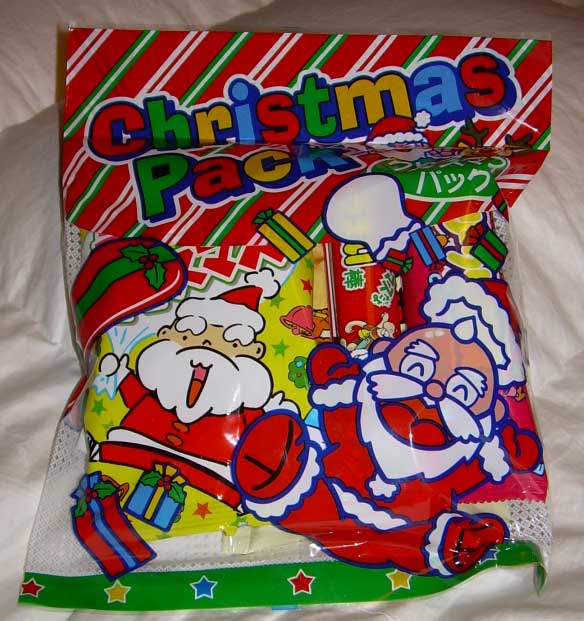
Christmas Pack 2

The Japanese on this bag says the same thing as the English, "little Santa" (ri-to-ru sa-n-ta).

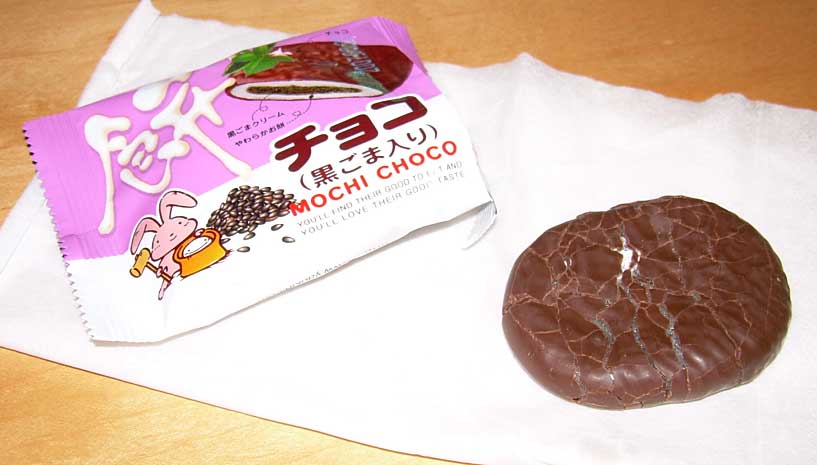
Last year, I picked up a "Christmas Pack" at the local 99 yen store to see what sort of goodies are peddled to Japanese children at this time of year. Though I had no intention of "taking the bullet" again in terms of trying another and reporting on its contents, time heals all wounds or at least allows the palate to forget. In the holiday spirit of giving (in this case, information) and self-sacrifice (my taste buds), I picked up another Christmas pack this year.

There was actually an increased variety at my local QQ (99 yen convenience store) this time around. One featured the same spastic Santa design from last year though it appeared to have different contents. Another was in an opaque bag and I couldn't see what sort of things were in it at all. I went for the bag pictured above because I didn't want to buy the one with the scary looking mochi disc since the mochi choco from last year's bag was exceptionally vile. In fact, I'm feeling queasy just remembering it.


This bag also included a relatively inoffensive-looking item, a castella doughnut, right in the front. "Castella" is all over the place in Japan both as slabs of cake and as doughnuts. I've had the cake before because it had been offered as a souvenir at my former office. The cake has a coarse texture and is oddly tacky because it has a slight stickiness. It's quite sweet though not in the same way as western cakes which have an intense processed sugar quality. It's more of a honey sweetness quality. The cake itself has a nice flavor but the texture is not as fine as western sponge cakes. Like many other sweets (konpeito) and bread (pan) in Japan, castella is adapted from original Portuguese recipes (hence the un-Japanese name).

Though I've seen both the cake and doughnuts everywhere, I've never purchased either so this doughnut was my first sampling of a "castella doughnut". Keep in mind that I've never seen what one might consider a high quality castella doughnut. They seem to be sold in large bags for a low price by and large. I've never seen one in a bakery, for instance, so I think they're a low rent food regardless of whether they're in a cheap ass bag of goodies or in a big family-pack at Inageya supermarket.

The donut in this packet didn't seem to resemble castella cake in any fashion. It smelled vaguely of vanilla and oil. In fact, it was pretty much a somewhat dry cake donut with an exceptionally greasy exterior that left a sticky coating on my fingers which didn't easily come off. The strongest taste I got from it was one of old cooking oil and this compelled me to check the expiration date to see if it had been sitting around for a long time. The date was February 26, 2008, so it wasn't as old as the well-aged oil flavor indicated. If I were even moderately curious to try a castella donut before, this pretty much quashed any desire I may have had to eat one.


Choco-Taro..."you will enjoy it's taste". I wasn't sure if that was an order or a promise, but, either way, I wasn't looking forward to finding out. The bar smelled vaguely of something resembling chocolate and was covered in a paper thin coating of mockolate. Though it claims to have peanuts, it seemed only to have microscopic fragments embedded in the (too sweet) coating. If you imagine one of the little puffed rice grains in a Nestlé Crunch expanded to bar size with similarly enlarged air pockets, you pretty much have the center of this thing. It wasn't awful, but it also wasn't appealing. It seems as though the main points in designing this bar were to first, make it crunchy, and second, make it very sweet. There wasn't much flavor in it.


I was pretty sure this ("Fubo-san taro") was the same wheat gluten snack as was in last year's pack with the only difference being the wrapper. A preliminary sniff revealed that it smelled of burnt sugar as last year's did, but it didn't carry the same vague whiff of beef bouillon cubes. The inside had a lighter texture than last year's "fu" snack and biting into it put in mind the notion of chomping into a tenderized Styrofoam packing peanut that had been liberally doused with sugar. This one was more edible than the previous one and I may have considered more than a few tentative bites if it weren't so incredibly sweet that I feared I'd go into diabetic shock. It is absolutely remarkable how sweet it is given that most of the flavor seems to be on the dusting of brown crap on the outside.


This is a salted snack food called "cabbage taro". Apparently, these are favored by frog policemen. That's a bit odd as I figured they'd favor the castella doughnuts (being in reptilian law enforcement and all). These smelled and tasted much like a Japanesse "corn potage" salted snack food I favor (but mainly avoid) in Japan. It's salty, has a bit of a chicken consommé flavor and only the vaguest hint of cabbage. The little specks of green aren't cabbage though. They are bits of nori (dried seaweed). There was so little of it though that it had almost not impact on the taste. These were actually rather tasty and had a nice tangy aftertaste to them. They were very crispy and light and brought to mind (the now defunct) Planter's cheese balls with a different flavor coating. I actually ate the whole (tiny) bag of these. It's the only item I completely consumed its entirety.

This is "morokoshi wa taro" or, essentially, "corn and corm rings". Among the ingredients are corn, taro (a Japanese corm), vegetable oil, and spices. They don't smell like much of anything and taste like an airier, relatively flavorless Chee-to. I'd call these rather inoffensive to mildly pleasant because of the texture.

The last item in the pack ended up being one of the same salted snack foods that I got in the previous year's bag. I couldn't see the front of the pack when I purchased it or I may have gone for the more terrifying spastic Santa bag with the white mochi hockey puck. After all, I do have to suffer if this is to be a true act of gustatory martyrdom. I've pasted my former bit of information as a caption on the photo above in case you don't want to go back and read the old post.

As was the case with last year's bag of "goodies", corn was the first ingredient for everything except the donut which listed flour as the first ingredient. I can see where kids might enjoy a bag of snacks like this, but it's all a bit much on the extremely low-end junk food side for an adult. Fortunately, my consumption was limited to a few tastes per item and then they hit the trash bin. I'm sure my body appreciates the consideration.

Sunday, December 09, 2007

Christmas Past

A small portion of the huge number of gifts under our tree in the past.

(Note: About 5 years ago, I had my sister send me all of our family photos and I scanned them in and burned them to CDs. I know family photos are boring to those who aren't members of the pictured families and that's understandable, but I'm going to stroll down memory lane alone even if no one else wants to come along with me. )

Despite the fact that my family was relatively poor, every Christmas I remember was a huge blow-out of gifts. My mother always went overboard and almost always went into big debt. I remember her taking out loans and putting items on lay-away months ahead of time. When I was a very young kid, I didn't know or think about the money aspect and my mother didn't share it with us until I was around 12 years old. At that point in time, the lavishness of our Christmas and the toll it took on the family finances complicated my enjoyment of the holiday. By the time I was an adult, I couldn't separate the presence of a plethora of packages from the fact that it represented my mothers shop-aholic nature.


Before I was old enough to know the financial flip-side of the gift-filled holidays we had, Christmas was an absolutely magical time where every wish we had seemed to come true. I think that my sister and I got the bikes pictured above when I was 6 and she was 8. That'd put the year of this particular Christmas around 1970 (but I'm not sure).


This is my sister (on the right) and I amongst a cornucopia of toys and a lot of discarded wrapping paper. One of those items is a generic version of an Easy Bake Oven. The box between us says "magic cool oven set". I guess that using a light bulb to cook tiny cakes must have seemed like "magic" to kids. I remember using up all the kid-size boxes of cake mix and then finding that my mother couldn't afford to buy us more so we'd try to adapt regular recipes but it never worked particularly well. When I discussed this picture with my sister, she said she loved that oven and used it constantly until it broke.

The funny thing is that I don't recall those bikes much at all except for a vague recollection of learning to ride by removing the training wheels on the smaller one that was mine. I only remember the oven in terms of not being able to use it anymore. The thing I loved the most and recall the most clearly, oddly enough, is the tall, plastic poodle which you can see the back of in this picture. I think it was full of bubble bath and could be used as a coin bank by cutting a slit in a slot in the back when the bottle was empty. I remember that there were two of them (one for each of us) and one was pink. It was incredibly cheap, but I really liked it.

The picture above was taken at the same Christmas picture with the bikes. Most kids would probably get the bikes and a few little things or the oven and a few little things, but we got it all. For us, Christmas was like one of those movies where a poor kid miraculously walks into a room full of every delight he could want at the end of the movie. It was quite spectacular. Looking back at these pictures helps me remember just how magic Christmas could be for a child.