Showing posts with label chocolate. Show all posts

Sunday, October 14, 2007

"Chestnut" KitKat


Living in Japan means that you will see new variations on two types of items on a continuous basis. One of those items is Pocky. For the two or three people who don't know what those are, it's an unsalted pretzel stick which has been dipped in various sweet coatings. The "core" version is chocolate but there is an ever-changing kaleidoscope of varieties of these items. Some of them are rather absurdly similar to one another such as the "Men's Pocky" which looks like a slightly darker version of regular Pocky (or maybe it's bigger, I never bought one but it's chocolate).

The other item with a constant stream of variation is the venerable KitKat. At the moment, the newest versions are caramel and chestnut. Since I'm not a fan of caramel, I avoided it but my husband tried it and thought it was pretty good. I did rejoice at the appearance of the chestnut one since I am a great fan of all things related to either hazelnuts or chestnuts. Though I can't be sure, I believe that this particular flavor is seasonal and probably was released in previous years but I wasn't looking at candy at the right time and missed out before. I do know there was a chestnut "KitKat" which was essentially a sugar wafer (no chocolate coating and more and bigger wafers).


The bar is very pale with a hint of beige. The inside seems to be layered with what one would hope is chestnut cream. With some inappropriately high expectations, I gave it a try. The first taste seemed sweet without much flavor and with a hint of what seemed to be coconut oil (though I believe it is some other sort of oil). The next bite had only the tiniest hint of something vaguely resembling chestnut. When we read the ingredients on the back, we saw that chestnut is the 8th ingredient after "yeast" so there's not much in it. The over-riding taste is, unfortunately, an overly sweet white chocolate with the tiniest whiff of something else behind it but not necessarily chestnut.

This is actually not an uncommon experience when trying the various flavored Kit-Kats in Japan (such as the green tea one). Most of the non-chocolate varieties seem to be very sweet white chocolate with coloring and artificial flavoring of various degrees of intensity. I guess part of the problem with making so many different types is that they are probably not equipped to do any sort of special combinations because they're working with the same machinery all the time and can't do much to enhance the flavor beyond pour new essences or chemicals into their vats of white chocolate. While this bar wasn't bad, it was far from the bee's knees and even a chestnut aficionado like myself wouldn't partake of it again.

Sunday, September 16, 2007

Trivial Chocolates


I haven't done any posts for awhile about souvenirs or gifts students have given my husband or me. One of the reasons is sheer laziness, particularly with going to the trouble of taking a picture but another is that most of the gifts have been nice but unremarkable. My husband brought home some chocolates the other day which we both found interesting.


This particular box of chocolates comes with 4 Trivial Pursuit cards and 24 miniature chocolate bars. The cards are in German so we can't read them but the concept is one I believe we'd never see back home in the U.S. There are a few reasons I think this and the primary one relates to the fact that I think, by and large, Trivial Pursuit is a game designed to attract adults and chocolate is mainly something targeted at children. The combination of these two things seems to be a way of encouraging people to see these as two great things that go great together, sort of like a game version of a Reese's Peanut Butter Cup.

The other reason I think it wouldn't be offered in the U.S. is that I believe Trivial Pursuit isn't something America finds all that attractive anymore. In fact, after the initial boom, I don't think many people were all that into it because they found the game too difficult for them. My husband and I used to play Trivial Pursuit and bought some of the later card sets and found that they seemed to be dumbing them down and specializing them in an attempt to make the game easier for people with a less than stellar general knowledge.

Of course, that's not to say I was incredibly great shakes at the game. While I did very well with science, art, literature, and entertainment, I was hopeless at sports and recent American history (though I was fine at earlier history and world history for the most part). For instance, while my husband knew everything Richard Nixon had done wrong and who had caught him, I was clueless about such details. Anyone with an interest in politics or baseball scores had a distinct advantage compared to someone who knew who painted "The Birth of Venus" or who had read "The Catcher in the Rye".

Back when we were playing this game though, the absolute worst category for me was sports. I didn't know anything about any sport (and still don't except for sumo) and it became a running joke that I would answer any sports question with "Pete Rose" even though I knew he was a baseball player and the question was about hockey or football. There were many occasions where I couldn't finish or win the game because I'd be trying repeatedly for that last sports and recreation piece of the plastic pie and never happen upon the type of question (recreation) which I had a shot at getting right. If it wasn't a question about playing jacks (or a non-sports game) or a scandalous and notorious sports personality in the last 5 years, I wasn't going to get the question right.

While, we did enjoy playing Trivial Pursuit together, my husband had too great an advantage and I too great a disadvantage and all the games ended the same way (with me chasing around that last orange wedge and never getting it). It was better when we teamed up with other people but our friends were often from other countries (the U.K., Australia, etc.) and our American version of the game carried a distinct bias for America-based information which was unfair to them. In the end though, computer games which took up less space to play and store usurped the role of board games in our lives. In fact, I'd pretty much say that Warcraft II was the first nail in the coffin of the more gentle days of sitting around a board, rolling a die and racking our brains to answer questions on cards.

Wednesday, May 30, 2007

Reciprocation


My husband returned yesterday from his week-long visit with his family in the U.S. (and there truly was much rejoicing as well as crying). There is more than one tale to tell but I'll start with souvenirs. In the past, I've mentioned that my husband has received gifts from students and now he's returning the favor. The picture above is the large quantity of See's candy that he bought to give to his favorite students.

There are 13 of the boxes with American flags. They each have 4 pieces of candy and cost about $5 each. My husband chose this design because these are souvenirs from a trip to the U.S., not out of some sense of patriotism. There are 4 of the seashell design boxes and they are pretty much the same as the flag boxes. They just have a different design. My husband will be giving these to the majority of students but the larger boxes wrapped in blue paper are 1 lb. boxes which he'll give to those he enjoys teaching the most (these cost $17.50). The peanut brittle and peanut chews are for anyone he misses with the chocolate, I guess.

This was actually a pretty sizable investment considering See's isn't cheap. However, my husband wants to show those students who have regularly taken his classes for the last few years and who have been fun to teach how much he appreciates them. I guess this may look to some extent like him greasing wheels to ensure that the students continue to be devoted to him but that's not the way he is. He's sweet, generous, sincere and genuine. That's why he has so many regular students who enjoy lessons with him. He doesn't need to bribe them with chocolates.


My husband is a particular fan of See's because he grew up with them and he wouldn't miss the rare chance to pick some up for us as well. This picture is of the friendly See's lady holding the two-pound custom box he picked out for us. I'm guessing it'll take us ages to get through this and it's currently sitting un-opened in the fridge.


One can buy See's candy in Japan (in Shibuya) but the prices are outrageous. My husband dropped by there awhile back and took some pictures. The box pictured above is of a 2 lb. gold box for $112. In the U.S., this box is $35.60. You can guess that we don't buy much See's in Japan and can't blame him for going a little overboard when he patronized one in the U.S.

Incidentally, there is a move by some major chocolate manufacturer's in the U.S. (Hershey's, for one) to re-define chocolate so that the cocoa butter content can be reduced and replaced by vegetable fats and the resulting product can be advertised as real chocolate (despite being more of a "mockolate"). See's was (and may still be) one of the companies that opposes this which is why the topic springs to mind. I actually don't mind if chocolate companies make this switch as long as they are required to print the fact that it's no longer real chocolate on the label. However, the way this is going, it will allow companies to make this substitution and not make it clear which candy is "real" and which is using cheaper ingredients.

Tuesday, February 13, 2007

Chocolate Chip Cookies


This recipe is a leftover from my Christmas baking binge. My husband has been off of sweets now for quite some time. However, with Valentines Day coming tomorrow, it seems appropriate to offer up a recipe with chocolate.

There are tons of recipes for chocolate chip cookies and, for most people, Toll House cookies are the gold standard. My husband doesn't like the way Toll House cookies are relatively flat and contain tons of chocolate chips. He likes a chocolate chip cookie which has a bit more "cookie" to it, so I've been modifying the recipe to make a puffier cookie with fewer chips.

If you live in Japan and make anything with brown sugar, you'll notice some differences that affect baking. Most standard western brown sugar is darker and has a deeper molasses flavor than standard Japanese brown sugar. You'll also notice that Japanese brown sugar will not pack when you measure it.

I've made this recipe with both Chelsea brown sugar (purchased from Nisshin supermarket) and Japanese brown sugar (which you get in any Japanese market). Using western brown sugar and packing it makes a flatter cookie so I have to add about a 1/4 cup more flour with western brown sugar. Also, the cookies are quite a bit lighter in color with Japanese brown sugar.

I've also make these cookies with a mixture of Crisco and butter as well as using Japanese "keiki margarin" (cake margarine) only and there doesn't appear to be much difference. If you're in Japan, it's simpler and likely cheaper just to use the cake margarine.

Modified Chocolate Chip Cookies recipe:
  • 3/4 cup brown sugar (packed)
  • 3/4 cup white sugar
  • 1/2 cup Crisco
  • 1/2 cup butter (softened but not melted!)
  • 1 tsp. vanilla
  • 1 tsp. salt
  • 1 tsp. baking soda
  • 2 eggs
  • 3 cups flour (if using western brown sugar; if using Japanese brown sugar - 2 3/4 cups flour)
  • 1 1/2 cups semi-sweet chocolate chips

Cream the brown sugar, white sugar, Crisco, and butter with an electric hand mixer. Add the salt, baking soda, and eggs and mix well. Add half the flour and mix again. At this point you'll have to mix with a large spoon or your hands. Add the remainder of the flour until thoroughly incorporated. Stir in the chocolate chips. Drop by tablespoonfuls onto an un-greased baking sheet, placing at least 2.5 inches between each. Bake at 375 degrees F./190 degrees C. for 10-12 minutes. Makes 3 dozen.

Sunday, February 11, 2007

Nova Pocky


There are some people who are absolutely crazy for Pocky (essentially an unsalted pretzel stick dipped in chocolate) but I'm not one of them. I think they're inoffensive but not especially appealing so I don't buy them regularly. Once in awhile, they will release a variety that I'll sample (like coconut) but it's quite rare.

While I was shopping at a local market today, I ran across Pocky with Nova conversation schools' ugly usagi (rabbit) mascot on the box. I'm not sure what compelled Nova to go with such a poor design but the Japanese supposedly went pretty crazy about it and collected items made in this thing's likeness. The company I used to work for was sold to an off-shoot of Nova two years before I stopped working there and our salespeople would get bugged by the clients they were trying to sell to for free Nova usagi collectibles. I also heard that on-line auctions offered stuffed usagi and whatnot which sold for an attractive amount of money.

Personally, I've always called this the "beak bunny" because the face looks like a chicken beak has been planted in the middle of a rabbit's face. Of course, the point is for the nose/mouth combo to look like a smiley face but it just looks weird. Nonetheless, I was intrigued enough to pick up this box of Pocky to see how Nova was linking to Pocky.


The two packets inside the box each have a drawing of the mascot and an English phrase with a Japanese translation. I guess the idea is to get people to study English on their snack packages. It's probably targeted toward kids for the most part. Though adults do enjoy Pocky, I think the notion that they'd study the packets is a bit far-fetched.


On the back of the box, another chocolate product made by Glico (the company that makes Pocky) is mentioned as part of the Nova campaign. GABA is a chocolate product which claims to help improve "mental balance". This chocolate includes Gamma-Amino Butyric Acid (hence the name GABA) which is supposed to soothe the nervous system. I guess Nova hopes to reach the kids via Pocky and the adults through GABA.

One thing I wondered is how much Nova had to fork over for this advertising campaign and if it all seems pretty ill-timed on the heels of the bad publicity they are getting over a handful of their teachers being arrested for drug possession. I also wonder how well this sort of marketing works to draw people into language schools.

Friday, February 09, 2007

Valentine's Day, Japan-style


The gift and card pictured above were a Valentine's treat given to my husband by one of his more generous female students. Inside, there's a gold box of chocolate truffles made in France. If you know anything about the way things work during the Valentine's holiday in Japan, you know this isn't an indication of any amorous intent on the student's part.

For those who don't know, the confectioners in Japan performed a profitable King Solomon act on the holiday and split it into a holiday in which men receive chocolates as gifts (Valentine's Day) and one in which women receive cookies or marshmallow-based treats or other white sweets (White Day). What's more, the chocolate gifts that men receive are usually based on mundane friendships or business relationships rather than romance. Female workers give chocolate to their male colleagues in many cases.


The chocolate women tend to give isn't elaborate for the most part. You find that women in offices tend to buy pre-wrapped tidbits of relatively pedestrian chocolates from convenience stores or supermarkets. Strawberry or cherry Kit-Kats are a particular favorite. This year there is a special Valentine's box of brandy and orange Kit-Kats for sale. In fact, I've never seen the heart-shaped boxes of candy that are frequently sold in the U.S. at this time of year. The truffles my husband received are definitely several cuts above the usual fare.

Most of the Japanese women I've spoken to about this are not fond of the way this works. I've been told that White Day is frequently forgotten and their Valentine gifts of chocolate are not reciprocated.

My husband also read a book quite some time ago (I wish I could remember the title) about the politics and psychology of Japanese office ladies (frequently called "O.L.s") and it mentioned that a lot of women use this holiday as a means of expressing some hostility toward their bosses. Besides spitting in the tea they served, they'd also carefully break apart all the chocolate inside it's wrapper before giving it over to their boss or coworker.

Surprisingly, the conservative, old-fashioned former president of my former company (he reigned for 10 years of my 12 there) was savvy enough to outlaw the giving of chocolate during Valentine's Day. He didn't want to impose the hardship of buying a bunch of pointless little gifts on what he knew were our greatly underpaid O.L.s.

Thursday, December 28, 2006

Turkish Delights


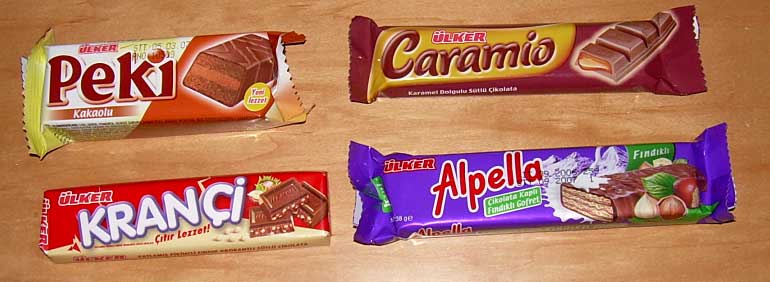
The Turkish coffee shop where my husband acquired dates (as I mentioned in a previous post) also carries imported candy bars. My husband doesn't tend to buy these types of things very often. However, he is often compelled to purchase such things when he comes across something we've never seen before, particularly if it is not made in Japan. I guess that buying chocolates only when they are novel is one way to reduce the frequency of one's consumption of sweets. These bars were relatively expensive so that would probably dissuade us from repeat consumption on a regular basis if nothing else does.

All of these bars were produced in Turkey and have information on them in 4 languages including Turkish and English. One of them also has Arabic writing. It's specifically stated on one that it contains "no lard and alcohol". I'm guessing this is to make it clear that it is acceptable for those of the Islamic faith.

My husband and I split the Alpella bar this evening and I had a small nibble of the Peki and Kranci bars. The Alpella was incredibly good and it required a great deal of restraint not to gobble it down in its entirety. It's wafers full of hazelnut creme (my favorite). The name "Alpella" is clearly meant as a play on "Alpine" and "Caramio" for caramel.

"Peki" means "okay" in Turkish and I'm guessing it is a translation of the Nestle "Yes" bar (which this bar closely resembles). There's no Nestle logo on the bar so it's either a rip-off or Nestle doesn't include its logo on it's Turkish products. I didn't care much for the Peki as it seemed overly sweet and had what I felt was an odd texture. The Kranci is straightforward chocolate covered specs of hazelnut.

My husband and I rarely buy Japanese chocolate except for the occasional special Kit-Kat once in a blue moon. I'm pretty sure Japan must have the world's record for greatest number of Kit-Kat flavor variations. To date, I have seen white chocolate, pumpkin, lemon cheesecake, green tea, cappuccino, coconut, strawberry, banana, mango, maple, sakura (cherry), adzuki (red bean), bitter, mild bitter, passion fruit, yogurt and there are several white chocolate varieties made with various kinds of milk from different regions of Japan.

The Wikipedia entry on Kit-Kats lists an even greater variety than I have personally seen. It also mentions that they are the number one candy bar in Japan and that "kitto katto" roughly translates into "I hope you succeed". That last bit of information was news to me. I'm sure it doesn't hurt to have a name that translates appealingly though I think the general appeal of a chocolate-covered wafer and an infinite variety of possibilities has a lot more to do with its success. One thing the Japanese market seems to love is novelty.

Tuesday, December 19, 2006

Fudge Brownies


If you search the internet for certain types of recipes, you'll find that a lot of them are duds even though there are reviews which say they're the bee's knees. Even good recipes for certain foods can disappoint. Homemade brownies are one type of food where the recipes often aren't quite up to snuff, particularly if you're a fan of the kind of fudge brownies with a nice crackly top and a fudgy interior that come from commercial mixes.

Fortunately for me, I don't often make brownies because it's quite a bit more sugar than I'd like to be eating. Unfortunately, on the rare occasions when I want them, I have no access to commercial mixes. Quite some time ago, I came across this recipe which includes an unusual step where you add boiling water. I haven't worked out what the chemistry is behind this step but I do know this is the homemade brownie recipe that comes closest to having the attributes of the venerable Betty Crocker mixes.

The nifty thing about this recipe is that it doesn't require you to deal with baking chocolate or other esoteric ingredients that are rarely on hand. It uses cocoa powder so, if you get a chocolate craving, you have a good chance of finding everything you need in the pantry and you won't have to run off to a grocery store. I use Van Houten cocoa because it's available in most Japanese supermarkets but I've had great results with Hershey's baking cocoa, too. I believe any cocoa will do fine (including the much cheaper Meiji brand in Japan) but there will be flavor variation depending on what kind you use. Hershey's makes a darker brownie with a slightly more bitter undertone. Van Houten makes a smoother-tasting brownie.

With the holidays coming up, you might want to give this a try as a special treat.

Fudge Brownies recipe:
  • 1/2 tsp. baking soda
  • 3/4 cup cocoa (unsweetened baking cocoa)
  • 2/3 cup butter (melted)
  • 1/2 cup boiling water
  • 2 cups sugar
  • 2 small or medium eggs
  • 1 1/3 cups flour
  • 1 tsp. vanilla extract
  • 1/4 tsp. salt
Preheat oven to 325 degrees F/165 degrees C.


In a large bowl, mix the cocoa and baking soda. Blend 1/3 cup of melted butter with the cocoa mixture. (It should look as above.) Note that this is half of the melted butter.


Add the boiling water and stir until well-blended. This will make a fudgey paste (as above). Be careful as it can be very hot (steam is still rising from it in the picture above). Stir the sugar into the paste. Make sure it has cooled enough not to cook the eggs when they're added then add the eggs and remaining melted butter. Mix well. Add the flour, vanilla and salt and mix well. Pour into a well-greased baking pan (13"x9"x2" or 9"x9x3") and bake for 35-40 minutes. Do not overbake. Allow them to cool for at least 15 minutes before cutting.

The best way to test for doneness is to see how liquid-like the center is. If it is very "viscous" in a 3-4 inch radius from the center when you gently rock the dish from side to side, it probably needs more time. A tester or toothpick test (inserting it in the center) will not work as it will come out with moisture on it when it is done. If it comes out clean, you've probably overbaked. The center should be soft to the touch but feel "set" like a soft set custard or pudding. If it feels liquid-like under the surface, it isn't done.

Please note that my friend tried this with Hershey's cocoa and his batter looked rather different than my pictures (in fact, he said his looked the opposite of mine at the two stages above). I'm guessing the fact that Van Houten is more water soluble has an impact on the batter. He also reminded me that the brownies are better the next day and actually get fudgier overnight.

Monday, October 09, 2006

Gifts from Students

The makings of a complete tea time snack

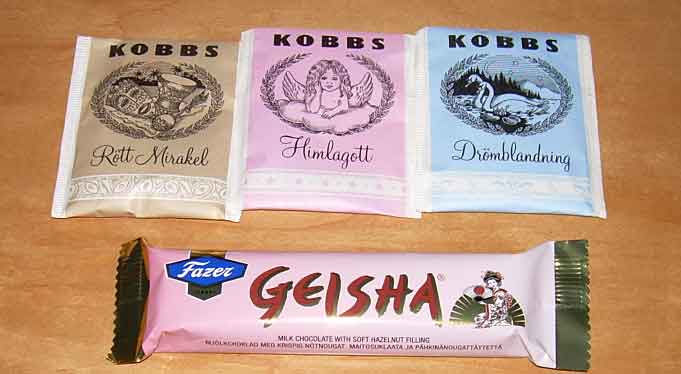
One constant about Japanese people is that they give gifts, especially souvenirs from their travels. Teachers in particular are recipients of their largesse. Since my husband sees a great many people each day at the conversation school where he works, it's not uncommon for him to bring home little surprises that students have given him. The above picture was today's takings. I first heard of Geisha chocolate, a Finnish confection, from Roy's blog. Roy didn't say anything about how good it is. It's full of extremely yummy hazelnut filling. The types of tea are written in Finnish but I believe it's vanilla, rooibos, and quince (vanilj, rooibos, and kvitten).

In the past, he's been given wine, dates, sake, various candies and cookies, bean cakes, mochi, nuts, maple syrup, coffee beans and wafers. My students have given me manju, green tea, lavender hand lotion and liquid soap, herbal tea, chocolate, fruit jellies, hand towels and, recently, ear medicine for my husband's ear blockage problems. They are nothing if not generous and inventive.

I've noticed my husband receives more food than anything else and I receive a mixture of food and personal items. I'm not sure if this is because I'm a woman or if it has to do with my teaching from the house and being a housewife. I tend to suspect it's the former.

Of course, the Japanese give each other gifts frequently as well. At weddings, each guest receives a bag (sometimes large, sometimes small) with souvenirs of the wedding. It's a nice custom though it tends to become a burden for them at times. More than one person has told me that the expense and obligation of gift-giving can be a bit tedious for them at times. That's not to say they don't often gladly give gifts, particularly to foreigners who they are under no obligation to give anything to.

One of my students told me about an experience he had recently related to gift-giving. An American couple that visited Japan recently had dinner with his wife and he and another Japanese couple at the other couple's home in Tokyo. He and his wife gave the Americans a framed picture of Mt. Fuji and the other couple gave them some Japanese lacquerware. The American couple didn't speak Japanese at all so the Japanese couples did their best to muddle through in English. Unfortunately, my student isn't very proficient though he tries hard.

When the American couple was preparing to leave, my student, a 64-year-old man, noticed that they had left their gifts in the corner of the room they had dined in. He said, "don't forget to leave it (the gifts) over there." The American man looked at him with great puzzlement and my student wondered what happened. When he explained it to me in the lesson, he was very embarrassed to realize he'd essentially said the opposite of what he wanted to say.

Wednesday, October 04, 2006

Very Hard to Find Items

One of the most frustrating things about living in Japan is that, when you really need an item which is basic and easy to find in the U.S., it can be nearly impossible to find in Japan.

My husband returned to a local fitness club after a long absence so he could start swimming again. Unfortunately, he forgot to put in ear plugs before he swam and got water in both of his ears. He further made a mistake when he used a Q-Tip to try and get it out causing it to block up more. Now he knows that was a bad idea but he wasn't aware of that until it was too late. His hearing has been fairly diminished as a result of this problem and there is some concern that, if it can't be cleared up, he'll develop swimmer's ear.

Since he teaches and needs to be able to hear well, it's rather imperative that he clear this up. After we researched the problem, we discovered that it's common in the U.S. to buy ear drops that will dry your ears up. After enquiring at 3 local pharmacies, he discovered that such drops aren't available in Japan and the only way to deal with this common, minor and easy to fix problem is to run off to a doctor. Hurray for the side effects of socialized medicine. :-p

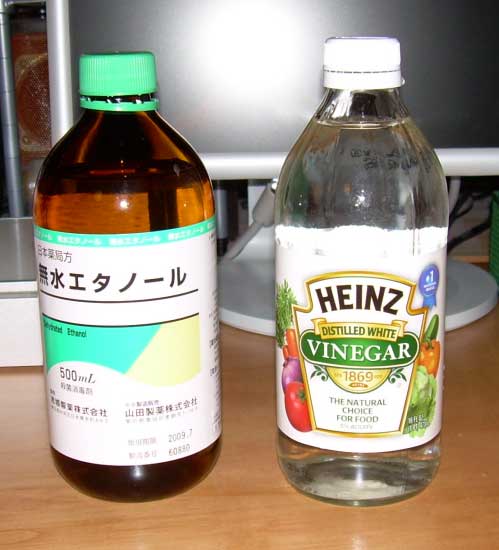
Rather than waste time and money going to a doctor, he investigated other options. Apparently, common treatment includes putting some drops of rubbing alcohol in your ear to dry up the moisture or a mixture of both alcohol and vinegar to kill bacteria and dry the ear.

In the U.S., both rubbing alcohol and distilled vinegar can be bought at nearly any supermarket or, at worst, a supermarket and drug store. In Japan, finding either of these items requires you to go to stores that specialize in selling items for foreigners. There may be some places that sell them but none appear to be in my area.


There is a wide variety of vinegar in most supermarkets but pure, distilled white vinegar doesn't appear to be in much demand and this is what you need for medicinal purposes. My husband had to go to National Azabu Supermarket in Hiroo to locate some. Rubbing alcohol also was tough to find but he located it at Koyasu Pharmacy in Hiroo. It was quite expensive as well. The bottle shown above was about $11 (1200 yen).


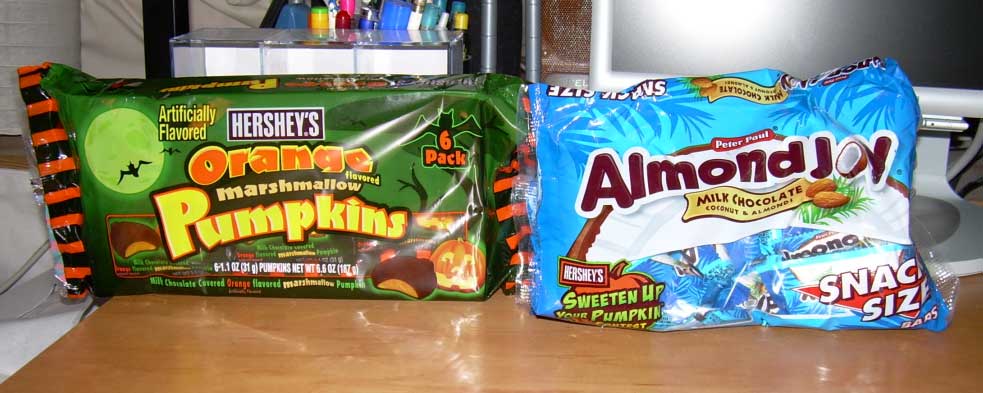
My husband decided to avail himself of the rare chance to indulge in some western sweets while he was there and picked up a couple of bags of Halloween candy. I haven't seen an Almond Joy in a decade or more and it's one of my favorite candies because I love coconut. Since I try not to eat sugar, this bag should last quite awhile. The marshmallow pumpkins are chocolate covered orange-flavored marshmallows and, while not bad, are not exactly a normal combination of flavors.

Wednesday, August 30, 2006

Cocoa Frappucino

Summer in Japan usually has everyone breaking out the mugicha (that's barley tea for those who aren't living in Japan) but I've never been a fan of any of the cold Japanese teas. I find them all roughly inoffensive and mugicha would actually be my favored cold tea among what I consider the 3 "biggies" - mugicha, oolong tea, and ju-rokucha (a blend of 16 ingredients in an herbal tea) but I pretty much prefer western drinks.

When I get tired of diet sodas and want something with more frost to it, I turn to a frappucino. Since Starbucks is a fair distance away and their frappucinos are full of sugar, I wanted to work out how to make one on my own. I'm sure this is a lot easier to accomplish back home than in Japan because crushed ice machines aren't commonly included with refrigerators here as they are in the U.S.

The first step is getting the equipment which isn't all that hard if you can locate a blender which is powerful enough to crush ice. I've had really bad luck with blenders burning out on me after short-term use though. So, I decided to order the ice crusher/blender attachment for my Braun Multiquick hand mixer. The good folks at Yodobashi will order all sorts of extras for you if you tell them the part number and the attachment is listed in the back of the Multiquick manual.

The Multiquick mixer unit along with a whisk attachment and a small food processor bowl can be purchased at Costco in Japan or at Amazon Japan for about 6,000-8,000 yen. I can't recommend this mixer enough for its various uses and small size. It beats my old small food processor hands down and makes a mean smoothie.

For a low-fat,sugar-free chocolate frappucino, the ingredients are:

1/2 cup low-fat milk
1 tablespoon (soluble) cocoa powder (Van Houten is very good and sold at Costco and some Japanese supermarkets)
1 tablespoon low-fat powdered milk
1 teaspoon of pectin (sold in supermarkets near the gelatin under the katakana letters - pe-ku-chi-n)
3 packets of sweetener (I use Splenda purchased from the Foreign Buyer's Club)
dash of vanilla extract
dash of cinnamon
about 1 cup of crushed ice (about 6-8 Japanese cubes)

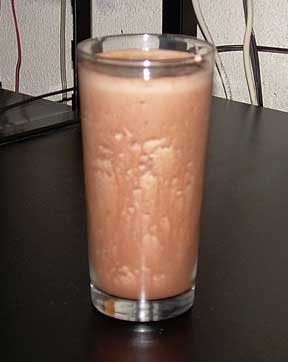
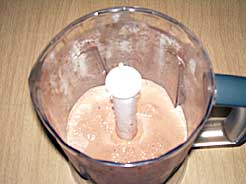
Put all of the ingredients except the ice into the blender and blend until it is mixed well. You should probably mix it for between 30 seconds to a minute to try and get the cocoa to dissolve and the pectin to thicken. Add the crushed ice and blend again for from 30 seconds to a minute until it resembles melted chocolate ice cream from the top (see picture below).


You can vary this recipe to make a coffee frappucino but be careful not to overdo the liquid relative to the ice quantity or all the ice will dissolve into the coffee and leave you with a coffee shake drink. Make sure you keep the ratio of liquid to ice the same (a half cup of liquid ingredients to a cup of ice). Also, make sure your coffee is very cold and strong if you use espresso and ditch the powdered milk but keep the pectin. In fact, I recommend you use 2 measures of ground coffee to one measure of water in your espresso machine to make it very, very strong and then use 1/4 cup of full fat milk and 1/4 cup of espresso as the 1/2 cup of liquid. Alternately, you could try the recipe above and substitute instant coffee for the cocoa powder although perhaps reducing the quantity.

All of these ingredients can be found in Japan relatively easily, particularly if you are flexible about brands. The hardest to find item at regular supermarkets like Seiyu or Ito Yokado is pectin. It is probably only carried by about 1 in 4 markets so you'll have to hunt around.

If you're on a diet and dying for something with chocolate, this will likely satisfy you with a very low caloric hit (about 70-100 calories depending on the milk type) and it's full of water so you feel full after drinking it.