Thursday, August 31, 2006

Effective Propaganda?

the full comic and original picture are at Coal's blog

This morning I ran into my landlord and had a curious discussion. As I posted yesterday, there was concern that I was upset about the cleaning crew that was cleaning the screens and the apartment just above mine. Apparently, the cleaning crew felt that, because I was American, I was unhappy and taking pictures in preparation to take some sort of "legal action." When I reassured the landlord that I would never do such a thing, he said he was relieved.

This conversation was odd not because I think it's inconceivable that a foreign resident might overreact and do such a thing but that my landlord would think I would do such a thing. I've lived in the same apartment for 17 years now. My husband and I have not complained about anything except when about 10 years ago the tenant above us was throwing dirty cleaning water out on her balcony which dripped down onto our laundry hanging on our balcony. We have also never missed our rent payments and pay "gift" money upon every rent contract renewal without complaint. That means we fork over an extra month's rent every two years for the honor of being allowed to continue to pay our regular rent each month for the next two years.

There's a long history of us not getting uptight about things and being decent tenants. So, why, after all this time, would my taking a few pictures result in the absurd conclusion that I was preparing for a lawsuit? And what exactly could I possibly sue about? A little cleaning-related noise? My screens temporarily being removed for cleaning? The guys parking in the street in front of the landlord's house?

After some time passed, I started to wonder if some of the propaganda I read about on Coal's blog is taking root. The full article with translated cartoons is available here but the gist of it is that foreigner's rights, if protected, will result in the Japanese having to tolerate bad behavior. The cartoons essentially say that discrimination is necessary to protect the rights of business owners and landlords from foreign people who will be disruptive and destructive.

I'm not concluding for now that this propaganda directly caused the cleaning crew's suspicion (which then led to my landlord's worries) because there are other possibilities. For instance, exposure to news of some of the more outrageous cases of litigiousness in the U.S. could easily lead the Japanese to believe we're all just looking for any pocket we can legally find a means to pick. I am, however, disappointed that my landlord didn't know better after my husband's and my long and well-behaved tenancy. It points out the sad fact that no matter how we behave, we are, first and foremost viewed as "gaijin" and subject to all the preconceptions and misperceptions that go along with being a foreigner in Japan.

Wednesday, August 30, 2006

Cocoa Frappucino

Summer in Japan usually has everyone breaking out the mugicha (that's barley tea for those who aren't living in Japan) but I've never been a fan of any of the cold Japanese teas. I find them all roughly inoffensive and mugicha would actually be my favored cold tea among what I consider the 3 "biggies" - mugicha, oolong tea, and ju-rokucha (a blend of 16 ingredients in an herbal tea) but I pretty much prefer western drinks.

When I get tired of diet sodas and want something with more frost to it, I turn to a frappucino. Since Starbucks is a fair distance away and their frappucinos are full of sugar, I wanted to work out how to make one on my own. I'm sure this is a lot easier to accomplish back home than in Japan because crushed ice machines aren't commonly included with refrigerators here as they are in the U.S.

The first step is getting the equipment which isn't all that hard if you can locate a blender which is powerful enough to crush ice. I've had really bad luck with blenders burning out on me after short-term use though. So, I decided to order the ice crusher/blender attachment for my Braun Multiquick hand mixer. The good folks at Yodobashi will order all sorts of extras for you if you tell them the part number and the attachment is listed in the back of the Multiquick manual.

The Multiquick mixer unit along with a whisk attachment and a small food processor bowl can be purchased at Costco in Japan or at Amazon Japan for about 6,000-8,000 yen. I can't recommend this mixer enough for its various uses and small size. It beats my old small food processor hands down and makes a mean smoothie.

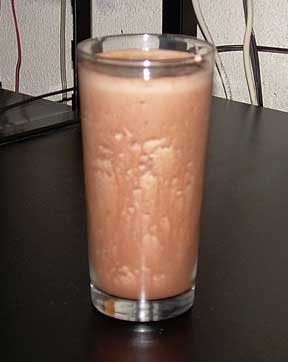
For a low-fat,sugar-free chocolate frappucino, the ingredients are:

1/2 cup low-fat milk
1 tablespoon (soluble) cocoa powder (Van Houten is very good and sold at Costco and some Japanese supermarkets)
1 tablespoon low-fat powdered milk
1 teaspoon of pectin (sold in supermarkets near the gelatin under the katakana letters - pe-ku-chi-n)
3 packets of sweetener (I use Splenda purchased from the Foreign Buyer's Club)
dash of vanilla extract
dash of cinnamon
about 1 cup of crushed ice (about 6-8 Japanese cubes)

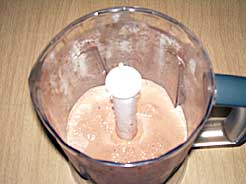
Put all of the ingredients except the ice into the blender and blend until it is mixed well. You should probably mix it for between 30 seconds to a minute to try and get the cocoa to dissolve and the pectin to thicken. Add the crushed ice and blend again for from 30 seconds to a minute until it resembles melted chocolate ice cream from the top (see picture below).


You can vary this recipe to make a coffee frappucino but be careful not to overdo the liquid relative to the ice quantity or all the ice will dissolve into the coffee and leave you with a coffee shake drink. Make sure you keep the ratio of liquid to ice the same (a half cup of liquid ingredients to a cup of ice). Also, make sure your coffee is very cold and strong if you use espresso and ditch the powdered milk but keep the pectin. In fact, I recommend you use 2 measures of ground coffee to one measure of water in your espresso machine to make it very, very strong and then use 1/4 cup of full fat milk and 1/4 cup of espresso as the 1/2 cup of liquid. Alternately, you could try the recipe above and substitute instant coffee for the cocoa powder although perhaps reducing the quantity.

All of these ingredients can be found in Japan relatively easily, particularly if you are flexible about brands. The hardest to find item at regular supermarkets like Seiyu or Ito Yokado is pectin. It is probably only carried by about 1 in 4 markets so you'll have to hunt around.

If you're on a diet and dying for something with chocolate, this will likely satisfy you with a very low caloric hit (about 70-100 calories depending on the milk type) and it's full of water so you feel full after drinking it.

Won't you be my neighbor?

no matter how clean it is, it still looks ugly

This morning I stumbled out into the kitchen to make the elixir of wakefulness (aka coffee) and noticed that the screen covering the kitchen window was half open. This allows a whole host of unsavory crawling and flying creatures to infiltrate my apartment. My husband is particularly peeved about mosquitos getting in and quite rightfully so. He's spent the last 3 days with two bites prominently on display on his forehead causing students to peer quizzically at them or ask about what happened.

I pushed on the open screen to close it and it fell right out of the frame onto the ground outside. I figured someone had broken it carrying something awkward to the apartment next door. I was dissuaded from this notion by a note on the genkan from my landloard explaining that the screens in the front of the apartment were being cleaned today. I wondered why the screens in the back of the apartment, which are so dirty that they give off puffs of dust if you bump into them, never get cleaned as part of the 2,000 yen a month maintenance fee we pay.

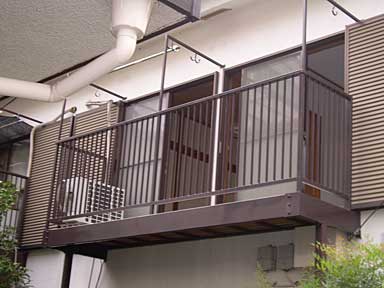
I figured out the reason why when I stepped out to go grocery shopping and noticed the apartment above ours (pictured above) had been vacated and was now being cleaned. They were sprucing up the front of the building so it'd look better for propsective tenants. They don't bother with the back because it's gated off and inaccesible.

This reminded me of the often stated (by both foreigners and Japanese alike) that Japanese people are only concerned about cleanliness in as far as it personally concerns them and have little concern for how their actions affect the environment of others. In other words, my landlord doesn't care about how clean my screens are. He only cares about how dirty the ones a possible tenant might see are.

All that being said, my landlord is a very nice person who has been supportive and understanding. He communicates with us in meticulously written notes in English (see below) or speaks to us in English. If I asked him to clean the back screens, he'd probably do it. He just isn't going to do it spontaneously. In fact, the very act of taking a few pictures for this posting made him worry that I was upset about what was happening and he called to apologize for the inconvenience. He's just that considerate.

Tuesday, August 29, 2006

The Many Meanings of "Diet"

pay no attention to the fingerprints on that oven

Even though I've been in Japan for a long time, I sometimes forget that anything labelled "diet" that is not produced by a foreign company is likely to be meant as an aid in losing weight. To an American, "diet" usually means a product has reduced caloric content.

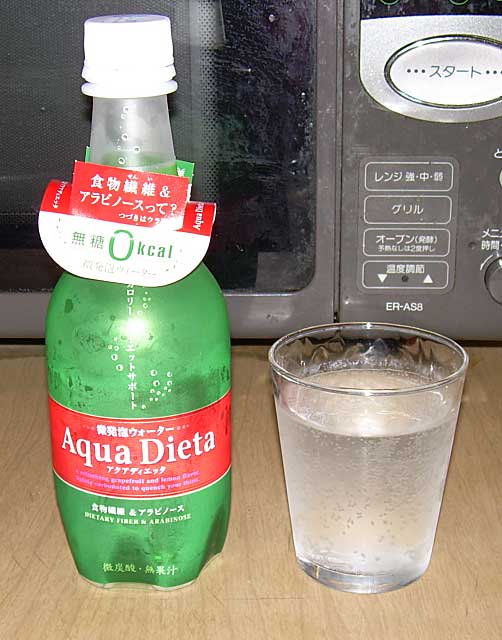
It was with a thoroughly American state of mind that I decided to pick up a bottle of "Aqua Dieta" at a local convenience store. Who doesn't want to try a lovely new diet beverage? A cursory look at the bottle caused me to think it was some sort of sugar-free grapefruit/lemon soft drink.

When I got home, I looked up the web site for the drink and learned that it is supposed to suppress appetite and provide fiber that will assist to that end. The two ingredients that supposedly accomplish this task are arabinose and polydextrose. Arabinose is a form of pectin (which is derived from the cell walls of plants) and it is used to thicken jams and jellies as well as some beverages. In fact, pectin is used in frappucinos made at Starbucks to make them thicker and creamier. Polydextrose is a partially indigestible synthetic substance made from sugar used for thickening and sweetening. It includes citric acid and sorbitol (a naturally-occurring low calorie sweetener with a laxative effect).

Despite having a thickener and a sweetener, Aqua Dieta tastes like mild tonic water. It is lightly carbonated and slightly bitter. I think there's not enough of anything in it to have an effect on appetite. A bit of club soda with a squeeze of lemon and grapefruit in it would probably be more satisfying with fewer chemicals.

Monday, August 28, 2006

Sitting, Sleeping and Storing Pretty


When I was a kid, I hated going camping with my parents. The primary reason for this was having to sleep on the ground in a sleeping bag. Given that the standard futon is little better than a good sleeping bag and tatami doesn't feel much softer than a good bed of grass, I wasn't very fond of sleeping on the floor in Japan either.

Initially, my husband and I dealt with this with an air mattress but waking up in the middle of the night on the floor for a week or so convinced us purchasing a real bed was in order. We visited the local Salvation Army and picked up a double bed for about 12,000 yen that served us for quite awhile. Eventually, we graduated to a real queen-size bed from the Simmons Gallery and it has since taken up most of our 6-mat bedroom.

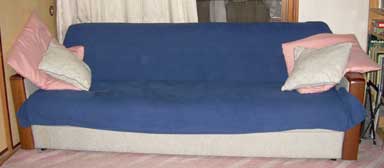
For those who are living alone though, I'd strongly recommend this nifty alternative, particularly if you're planning on staying more than a year and wouldn't mind investing about 18,000-40,000 yen on a nice piece of furniture. About 12 years ago, we bought the sofa pictured above. It has served us extremely well particularly as a second bed for guests or for my husband or I on nights when one of us is unable to sleep with the other for health reasons.

Unlike most sofa beds that you open up and pull out, this one slides and falls down flat so that the front and back join together seamlessly to make a platform you can sleep on (pictured below).


So, there's no danger of waking up hunched over like Elaine on Seinfeld because a bar was digging into your back. What's more, it's a snap to put away and set up. You pick up the base, the back slides down then you push the base forward until it clicks then lower it down. The same in reverse puts it away.

This being Japan though, there is an added bonus to using this sort of sofa bed. The base doubles as a very large storage area (pictured below).


If you live in a small apartment with a 6-mat room, small kicthen and bath, this is an incredibly smooth and comfortable way to allow it to double as a living room and bedroom. You can also use the space underneath for storing bedclothes or your own clothes.

We bought ours at Odakyu department store for about 35,000 yen but less elaborate but similarly functional sofa beds can be bought for 18,000 yen online from sofabed.jp.